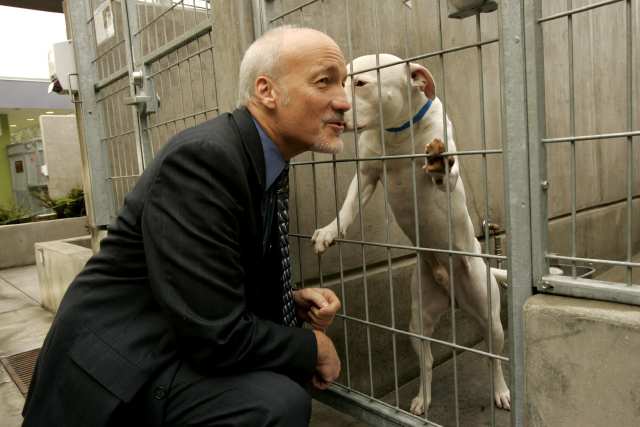
Over the past few days the LA Daily News misrepresented LA Animal Services on two occasions. The first instance was an article by Rick Orlav entitled, “Valley’s horse-rescue plan needs work”.
While I’ll agree that all emergency response plans need to be subject to constant review and improvement, the article suggests LA Animal Services’ role in the Sayres Fire is not clearly understood. LA Animal Services was there. LA Animal Services rescued over 400 horses. However, no mention was made of the fact that LA County Animal Care & Control was a no show until the rescue effort was nearly complete.
The only confusion during this entire episode resulted from whether LA Animal Services should go into the County to rescue horses outside of our jurisdiction or wait until County Animal Care & Control arrived. When it was clear horses would be lost if we didn’t act quickly, we of course went in – and as a result no horses were lost.
I made the recommendation to include a representative from Animal Services in the Emergency Operations Center to Councilman Dennis Zine nearly two years ago but to date he has taken no action and seems unaware of LA Animal Services critical role in these matters.
LA Animal Services performed exceptionally well and effectively saved hundreds of horses. They should be recognized for this heroic achievement – not criticized for the shortcomings of another department that couldn’t even get there on time.
The next article was an op-ed piece that appeared a few days earlier. I understand editors apply less scrutiny to want-a-be reporters, but LA Animal Services is such an open book that at any time the Daily News could simply have made a phone call to verify the facts before propagating the malicious myths manufactured by a chronic critic.
I refer to the piece entitled, “Finally, the end of an Ed Boks era.” The author suggests LA Animal Services is somehow broken and “spiraling out of control” and the only remedy is to follow his inexperienced advice. So, is LA Animal Services broken? Let’s look at the facts.
Keep in mind this partial list of accomplishments was achieved while the Department experienced its most historic growth and most severe budget cuts and staffing shortages simultaneously; a significant challenge for any manager.
Still, we built the highest volume pet adoption program in the nation; achieved the lowest euthanasia rates in the Department’s history; opened six LEED (Leadership in Energy and Environmental Design) Certified animal care centers; increased staff size 100%; and recruited a record number of volunteers.
We firmly established the Animal Cruelty Task Force; improved Pet Shop and Circus Animal Regulations raising the standards for humane care; formed a coalition of over 100 animal welfare organizations to enhance our adoption efforts; produced two animal welfare television programs, and established an exceptional veterinary medical program and executive team.
Not only is LA Animal Services not broken, it is better positioned than ever to help establish LA as the most humane city in the nation.
If you would like to be part of a winning team please consider volunteering with LA Animal Services and/or by making a donation to one of LA Animal Services life-saving programs.
That is the question being debated in Beverly Hills this month. The debate officially began on Wednesday, July 1st, when a 65-year-old Feral Cat Colony Manager named Katherine Varjian appeared before a judge in the Beverly Hills courthouse charged with the crime of feeding feral cats.
To be sure there are some technical issues regarding the law and Beverly Hills’ contract with LA Animal Services, but this case begs a fundamental question, “should compassion be outlawed?”
While I am sure no one in Beverly Hills wants to outlaw compassion, it should be understood that criminalizing the feeding of feral cats does just that. Although municipalities may deliberately or inadvertently outlaw compassion by ordinance, they can never stop it. When compassion is outlawed compassionate people will turn outlaw before denying their better angels. Ms. Varjian may be a case in point.
This case presents Beverly Hills with the opportunity to once again take a national leadership position; just as they did in December, 2008 when they officially became a “Guardian City.” In that decision, the Beverly Hills City Council demonstrated their compassionate intentions by “recognizing animals as Individuals, not objects”, adopting programs designed to “change public attitudes towards animals and provide positive impacts on local communities”, and “decrease animal abuse and abandonment.”
Surely this commitment and this case present a unique opportunity for the City of Beverly Hills to expand the circle of compassion to include feral cats.
What Are Our Choices:Communities typically employ one of three methodologies to deal with feral cats: 1) Do nothing, 2) Eradication, or 3) Trap/Neuter/Return (TNR).
While it is easy to understand why doing nothing has little effect on reducing feral cat populations (and, in fact, encourages growth), it may not be as easy to understand why eradication does not work.
Although some communities continue to employ eradication (“do not feed” “catch and kill”) as a remedy, decades of eradication efforts in communities across the United States has irrefutably demonstrated that this methodology does not work. There are two very real biological reasons why eradication fails every time.
Wild animals tend to have strong biological survival mechanisms. Feral cats, which are wild animals, typically live in colonies of six to twenty cats. You often never see all the cats in a colony and it is easy to underestimate the number of feral cats in a neighborhood. When individuals or authorities try to catch cats for extermination this heightens the biological stress on the colony.
This stress triggers two survival mechanisms causing the cats to 1) over breed, and 2) over produce. That is, rather than having one litter of two to three kittens per year, a stressed female could have two or three litters per year of six to nine kittens.
Even if a community was successful in catching and removing all the feral cats from a neighborhood, a phenomenon called “the vacuum effect” would be created.
When some or all the cats in a colony are removed, cats in surrounding neighborhoods gravitate toward the ecological niche vacated. When a colony is removed but the natural conditions (including food sources) remain, the natural deterrents offered by an existing colony of territorial cats evaporate and the neighboring cats quickly enter the newly open territory, bringing with them all the associated annoying behaviors.
As we’ve seen time after time in location after location all over the country, the end result of the “catch and kill” methodology is always the same: The vacated neighborhood quickly finds itself overrun again with feral cats fighting and caterwauling for mates, over breeding, and spraying to mark their new territory. “Catch and kill” never provides a lasting solution and can easily exacerbate the problem.
Albert Einstein defined “insanity” as doing the same thing over and over again expecting different results. That is why so many communities are abandoning the failed “catch and kill” methodologies in favor of trying the newest and only humane, non-lethal alternative: TNR (Trap/Neuter/Return).
TNR is being practiced in more and more communities across the United States and around the world with amazing results.
While I was in Maricopa County, TNR was so successful that the County Board of Supervisors enacted a resolution declaring TNR the only viable methodology they would approve for addressing the feral cat problem in this County of 24 cities and towns (including Phoenix) spread out across nearly 1,000 square miles.
While in New York City, we observed a 73% reduction in the number of stray cats impounded in a targeted zip code on the Upper West Side of Manhattan over a 42-month period of practicing TNR. TNR, correctly administered, is the only methodology that guarantees a reduction of the feral cat population in a community.
When TNR is employed effectively, all the feral cats in a neighborhood are trapped, sterilized, and returned to the area where they were trapped. They are returned under the care of a Colony Manager. The Colony Manager is a trained volunteer in the neighborhood willing to feed, water, and care for the colony and watch for any new cats. Once the colony cats are all neutered, new cats tend to be recently abandoned domestics that can be captured and placed for adoption.
Ms. Varjian is a Certified Feral Cat Colony Manager; trained and certified by Dona Cosgrove Baker, President and Founder of the nationally recognized Feral Cat Caretakers’ Coalition.
There are many benefits to TNR: 1) TNR prevents the vacuum effect from occurring. 2) TNR dramatically mitigates the troubling behaviors of intact cats: fighting and caterwauling for mates, and spraying for territory. 3) Altered cats provide rat abatement, a service many neighborhoods value, such as the Flower District in Los Angeles, and 4) because feral cats tend to only live one-third their natural life span the problem literally solves itself through attrition, provided TNR is implemented community wide.
TNR also addresses the concern that feral cats tend to create a public nuisance on campuses and in parks. There is an old adage that claims you can’t herd cats. In fact, you can herd neutered cats because they tend to hang around the food bowl. Because neutered cats no longer have the urge to breed and prey, they tend to follow the food bowl wherever the Colony Manager takes it. Feral cats can be trained to congregate in campus or park areas out of the way of the public or other wildlife.
When you review LA’s statistics it is clear that free-roaming cats represent our biggest challenge to achieving No-Kill.
Nothing hinders Beverly Hills from joining the City of Glendale and other communities who have already embraced TNR. It is my hope that Katherine Varjian’s case will open the door to a deliberative dialogue on the effectiveness of TNR for our residents, our wildlife and our feral cats.
Citizens interested in voicing their opinion on this matter can attend the next Beverly Hills City Council meeting where the question of reinstating a prohibition on feeding feral cats will be reconsidered. The question is much bigger than feeding or not feeding feral cats. The question that needs to be answered is, can we as a community come up with a humane, non-lethal solution to our feral cat problems. I believe the answer is a resounding “Yes”.
The next Beverly Hills City Council meeting is scheduled for Tuesday, August 4th at 7 p.m. at the Beverly Hills City Council, Rm. 400 (Council Chambers) located at 455 N. Rexford Drive, Beverly Hills, CA 90210.
If you cannot attend you can voice your opinion by contacting your Beverly Hills representative by letter, e-mail, fax or phone. (Phone: 310-285-1013, Fax: 310-275-8159)
More than a policy and statistical objective, “no-kill” is a principle, an ethic, and once applied the practical consequences begin to fall into place. The principle is that animal shelters should apply the same criteria for deciding an animal’s fate that a loving pet guardian or conscientious veterinarian would apply. That is, healthy and treatable animals are not killed simply because of a lack of room or resources to care for them.
Killing animals for lack of space may be the quick, convenient and, at least from afar, the easy thing to do. But I have never, in nearly 30 years in this field, heard anyone argue that it is the right thing to do. After all, the creatures who fill our shelters can hardly be faulted for bringing trouble upon themselves. People who seek to excuse euthanasia in shelters often say we have to be “realistic.” But such realism is best directed at the sources of the problem and at the element of human responsibility..
There are the heart-breaking cruelty cases that bring so many animals to our doors. On top of that, there are the thousands of dogs and cats shelters take in each year who are actually relinquished – turned in – even after years living with a family – like old furniture donated to charity. And there are the orphaned, neonate puppies and kittens. No one bothered to spay or neuter the parents, and so the offspring are born into the world homeless or unwanted. The general attitude is, “Let someone else deal with the problem,” and – hundreds of times a year – someone else does with a lethal injection.
Along with such failures in personal responsibility is a breakdown in social responsibility. On the budget sheets, saving animals can seem to a certain mindset as being a lowly or trivial concern. That’s an easy position to take, as long as you don’t have to be there when the problem gets “solved”. If the people who brush off animal-welfare as “trivial” had to see the product of their priorities carried out – to witness for themselves how trusting the dogs are even when being led to their death, or how as they drift away they lick the hand or face of the person with the needle – I suspect they would see matters in a very different light, and would enthusiastically support life saving programs.
I can see rays of light. There is a renewed community commitment to helping lost and homeless animals, and to swearing off euthanasia as a solution to pet overpopulation.
The “no-kill” ethic is a matter of taking responsibility, instead of excusing the problem or hiding its consequences.
No matter how you do the math, there are still too many creatures who have love and devotion to offer, but never get their chance. And calling the practice euthanasia (as some prefer), instead of killing (as others prefer), doesn’t make it any kinder.
The practice of killing animals has never been anyone’s idea of an ideal solution – let alone anyone’s idea of giving “shelter” to creatures in need. And, up close, the willful elimination of healthy animals with good years left is a sight to move the hardest heart. It is time we as a community make this commitment: No animal that comes through our shelters will be killed out of convenience or a lack of space. For every one of them, there is somewhere a kind and loving person or family, and it is our mission to bring them together.
LA Animal Services’ February 2009 statistics are now available. Something truly remarkable seems to be happening. Despite encountering the highest January/February impound rates in nearly a decade we were able to achieve the lowest January/February euthanasia rate in the department’s recorded history. And this was done without overcrowding our Centers! This is a tribute to all our employees, volunteers and partners! Well done! Thank you for all your efforts!
So how did this happen? From lessons learned!
Over the past two years, LA Animal Services experienced the largest, fastest, most historic growth in service demand in its history. With the opening of our new and expanded Centers we experienced nearly a 250% increase in kennels and workload while Center staffing increased only 100%. The new facilities attracted a greater client base, leading to more animals turned in, redeemed, and adopted. More people are now coming in to adopt and relinquish pets, obtain information, more veterinary care is needed and provided, and more volunteers and trainers want to help. This is exactly the business of LA Animal Services, and it is all being managed with a minimum workforce.
As the Department moved into its new Centers we encountered a learning curve for effectively managing our new facilities and our enlarged shelter populations. As the new Centers began to open in late 2006 we realized in 2007 the lowest euthanasia rate (15,009) in the department’s long recorded history of statistics gathering (since 1960. Over 110,000 dogs and cats were euthanized in 1971).
The low euthanasia rate in 2007 was the result of many reasons, but most notable was our having more space to hold animals coupled with a robust adoption program. In 2008, as we were still moving into our new Centers, we experienced a 20% increase (54,191) in intakes due in large measure to the economic downturn. This increase was complicated by our inexperience managing so many animals in all this new space. Consequently, the shelters quickly filled up (sometimes to the point of overcrowding), animals got sick more often and we sometimes found ourselves forced to resort to euthanasia to bring populations under control again. The nearly 30% increase in adoptions in 2008 did not keep pace with our 20.5% increase (nearly 150 dogs and cats every day) in intakes.
LA Animal Services had to quickly find its balance in an environment of severe budget cuts, unprecedented demand for expansion of services, and a severe staffing shortage. The Department had to re-group, tone-up and empower staff (especially at the mid-management level) to improve accountability and effectiveness.
Having gone through this painful growth experience, our Center Managers are now constantly looking for ways to better promote their adoptable animals more effectively. They are on the lookout for more and better off site adoption partners and events. The Department is exploring partnerships with pet stores interested in abandoning puppy mill sources. Our veterinarians are spaying or neutering some animals in-house. This allows our adopters to take their new pets home on the day of adoption. And our Veterinary team is implementing an enhanced cleaning regimen designed to help maintain a healthier shelter population.
We are aggressively transferring animals to one or another of our six adoption Centers or another municipal or private shelter when appropriate to increase adoption options. We’ve developed and are strictly adhering to a Population Assessment Management program that maintains our Center populations at least 10% below maximum capacity to allow sufficient space for incoming animals.
Another significant innovation that we are in the process of implementing is a program called, “Heart-to-Heart”. This program focuses on animals in our Centers longer than two weeks. Each Center has a Heart-to-Heart team that includes the Center Manager, the Center Veterinarian, the ACT Supervisor, and the New Hope Coordinator or their designees. This team works together to help decide the best options for animals that don’t get adopted in their first two weeks in a shelter. The team is charged with considering and exhausting all avenues of release, including but not limited to mobile adoption events, New Hope and other marketing pleas, transfer to another Center or agency, etc, etc.
So, are these strategies responsible for the positive statistics below? Time will tell. The Department will continue to monitor, tweak, manage, and modify as we continually learn from our mistakes, our successes, and the counsel of others.
Intakes/Rescues: February 09 Intakes were up over 7% (from 3,010 to 3,225). This is the highest February Intake since collecting data electronically began in 2001. February 2001 Intake was 3,079. Year to Date (YTD) Intakes are up over 4% (from 6,275 to 6,542). This is the highest January/February Intake since 2001 when 7,034 animals were taken in. This is a disturbing trend continuing from 2008.
Adoptions: February 09 Adoptions are up nearly 18% (1,607) compared to February 08 (1,377). YTD Adoptions are up 17.6% (from 2,848 to 3,351).
New Hope: February New Hope Placements are down nearly 7% (from 329 to 306). YTD New Hope Placements are down just over 10% (from 714 to 638).
Return to Owners (RTO): February RTOs are down 2% (from 376 to 368). YTD RTOs are down 6.5% (from 793 to 741).
Euthanasia: February Euthanasia is down 11% (from 748 to 665). YTD Euthanasia is down 14% (from 1,568 to 1,345). This is nearly 3% lower than the historic 2007 low of 1,384).
Again a sincere Thank You to all our employees, volunteers and partners for all their efforts to help support these life saving strategies.
There is a fundamental tenet held among most animal welfare and animal rights advocates that we accept as incontrovertible. That precept was perhaps best articulated by Mahatma Gandhi when he said, “the greatness of a nation and its moral progress is best judged by how we treat our animals”. This principle expresses the belief that when a community is compassionate enough to care about the needs of its animals there can be a reasonable expectation that the bar is raised on how we care and treat one another.
The reverse is also true. If we can dismiss the needs of our animals it becomes easier to dismiss the needs of our infirmed, aged, and needy human populations. Caring about animals serves as the ultimate litmus test for determining a community’s capacity for compassion.
This test is applied to the City of Los Angeles every day, but never more than in the spring and summer months.
Spring is the beginning of kitten season in Los Angeles. In 2008 LA Animal Services took in over 7,300 neonate kittens. Neonate means too young to survive for more than an hour or two without a mother. Sadly, most of the neonate kittens we take in are orphans. People find these babies in their garage, flowerbeds, and many other places where the mother felt safe from predators and intruders while she gave birth. Property owners find these crying babies within hours or days of birth and bring them to our Centers without the mother. Taken away from their mother they have no chance at survival without significant human intervention.
Neonate kittens represent over one-third of all the cats taken in by the Department. They also represent over 35% of all the cats euthanized and over 21% of our euthanasia rate in 2008. One in three cats and one in five animals euthanized in LA is a neonate kitten. On the up side, most of our healthy weaned kittens get adopted. So anything we can do to help our neonates reach full “kittenhood” improves the odds of their eventually finding a loving home.
Kitten season in Los Angeles starts around the end of March and lasts through September when it starts to slowly decline over October and November. That means now is the time for everyone wanting to help end the killing of these innocents to contact LA Animal Services to either volunteer to foster a litter of kittens or to make a donation to help others willing to make this commitment.
The Merriam-Webster Dictionary defines “foster” as providing parental care and nurture to children not related through legal or blood ties. If Gandhi viewed animals in general as the first rung on the compassion ladder then these little creatures must be considered the least of the least. They can be so easily overlooked and forgotten. In fact, California State Law defines “adoptable animals” as only those animals eight weeks of age or older; which means these little orphans have no legal standing in the State of California. They don’t even have to be counted in the City’s no-kill goal. Nonetheless, they are because we understand that our moral progress depends on our providing adequate care and nurture to these living souls with whom we have no legal or blood ties.
The problem is that we can’t save them all by ourselves. We need your help. During kitten season LA Animal Services can take in over 80 neonate orphans a day, over 2500 in some months. Depending on their age they may require four to 8 weeks of intense foster care. Though dozens of our dedicated employees volunteer to foster neonate litters above and beyond their daily duties, the majority will not survive without the additional help of members of the public willing to step up to the challenge. They will not survive without your help. If you are able and willing to help save these lives, LA Animal Services will provide the training, support and supplies you need to be a successful foster parent.
This is a big commitment and a true test of our compassion. Even with our best efforts not all foster babies survive. But they can all be loved. These babies need to be bottle fed every two hours around the clock for several weeks; making this the perfect family, club, or faith based organizational project. Fostering helpless neonates is an ideal way to foster compassion and respect for the true value and sanctity of all life in our community.
Have you saved a life today? Make a commitment to volunteer as a Baby Bottle Foster Parent. Our kittens are hoping you do!
By National Public Radio’s (NPR) National Desk reporter Carrie Kahn who covers news from Los Angeles. Kahn’s reports can be heard on NPR’s award-winning news programs including All Things Considered, Morning Edition, Weekend Edition, and Latino USA. Morning Edition,December 30, 2008 · Purebred dogs go for top dollar in pet stores around the country, but buyers of cute, cuddly puppies may not know that some come from unregulated breeding mills overseas. So-called puppy-mill dogs are showing up sick and dehydrated at major airports around the country.
In Los Angeles, one recent shipment of dead and ailing puppies from South Korea got the city’s attention. Twenty of the dogs in the shipment seized at Los Angeles International Airport either had died or had to be euthanized after the trip. The 10 survivors were turned over to the city’s shelter.
Five months later, those survivors — five miniature Maltese and five tiny Yorkshire terriers — were ready for adoption. Hundreds of animal lovers, many wrapped in blankets to keep warm, lined up on a chilly morning in front of L.A.’s East Valley Animal Shelter for a chance to bid on the dogs.
Ed Boks, the general manager of L.A. Animal Services, is required by City law to hold an auction when more than one person wants an animal.
“I want to begin with a few facts that you won’t commonly hear from your local pet store concerning puppies just like these that can often times sell for $3,500 or more,” he told the crowd.
Boks said the 10 minipurebreds arrived with forged health certificates. The documents put their ages at 5 months, but they were actually only 5 weeks old.
“These puppies are the product of a cruel, factory-style dog breeding operation that produces animals with chronic health problems, temperament issues and hereditary defects, so our message to all of you this morning is buyer beware,” he warned.
Overseas Puppy Mills Proliferate
Puppy mills began proliferating overseas about five years ago, at about the same time that U.S. authorities started cracking down on unscrupulous domestic breeders.
Tom Sharp of the American Kennel Club says that’s when he started seeing bulldogs arriving from Russia and Yorkies from South Korea. With the help of the Internet, Sharp says, dishonest pet stores and breeders could easily get puppies overseas.
“That way, they don’t have to be inspected by the different organizations and the governments here in the U.S., and avoid all the requirements,” he says.
Right now, the only federal requirement an importer has to follow is to provide proof of a current rabies vaccine — documentation that is easily forged.
Federal regulators say that rule was written at a time when the only dogs coming into the United States were companion pets. Nina Marano of the Centers for Disease Control and Prevention says Congress just passed a law banning the importation of dogs under 6 months old for resale.
But Marano says it will take at least two years for the ban to be enforced.
“We can try to regulate our way out of it, but another part is, I think, the issue about demand — that there needs to be a lot more public education about the demand that is being created for these puppies,” she says.
A Winning Bid
The demand was high for Los Angeles’ puppy-mill survivors.
One winning bidder was Debbie Garringer. “I was really lucky, and I’m happy, so happy, and I will take care of it so much and it will have a beautiful home,” she said.
All 10 of the purebred puppy-mill survivors got new homes, as did 52 other pets from the shelter. In all, Animal Services raised more than $20,000 and got its message out: Adopt, don’t shop.
Dionne Warwick joined me in announcing LA Animal Services’ innovative new program proposed by realtor Adele Langdon. Inspired by Dionne Warwick’s smash hit, “A House is not a Home”, it occurred to Adele that there was a way to make a house a home and that was by adopting a pet.
Adele designed The House is not a Home without a Pet program to help our community’s homeless animals. The foreclosure crisis in Los Angeles has resulted in a 28% increase in the number of pets surrendered to LA Animal Service since the beginning of 2008. This has led to the first increase in pet euthanasia in over six years. Keller Williams has decided to do something about that and to challenge all Los Angeles Realtors to help.
The program encourages real estate agents to purchase a $100 Gift Certificate from LA Animal Services to present to their clients at the close of escrow of their new home. The Certificate becomes effective 30 days after the close of escrow and is effective for one year. The Certificate is good towards the adoption of a dog, cat or two bunnies.
Beverly Hills Real Estate Agent Adele Langdon pioneered the House is not a Home without a Pet program
Adele convinced Keller Williams Realty of Beverly Hills to spearhead the program. The Beverly Hills Office encourages other Keller Williams Offices and Real Estate companies to get on board.
“Keller Williams is delighted to partner with LA Animal Services on this life saving program,” said Rob Aigner, Team Leader of the Beverly Hills Office. “’A House is not a Home without a Pet’ provides our agents and clients a wonderful opportunity to play a meaningful role in helping homeless pets, the silent victims of the housing crisis. It is our hope that all the real estate offices in Los Angeles will join this noble effort.”
“Finding good homes for our shelter animals is a top priority,” added Mayor Antonio Villaraigosa, “and ‘A House is not a Home without a Pet’ is a great example of a public-private partnership that benefits those animals and homebuyers alike.”
“Foreclosure pets are a societal problem,” said Tony Cardenas, City Council Member for District 6 and a former real estate agent himself. “We have a responsibility to help solve this problem and I applaud Keller Williams for taking a compassionate lead. It is my hope that real estate offices everywhere will follow this example.”
Keller Williams is announcing the program with a full page ad in this week’s MLS Caravan magazine received by all LA real estate agents.
It is disheartening to learn of acts of animal cruelty that seem to continue despite the concerted efforts of so many animal welfare agencies dedicated to the prevention of animal mistreatment. We recently learned of an incident where a young man hiking in the forest found two Chow mix puppies that had obviously been abandoned. These little guys were no more than four weeks old, and had been left alone to face whatever fate might befall them.
Fortunately, the fellow who found these pups was able to locate a rescue agency that could take them, and it appears that these two are going to be OK. However, this form of animal cruelty seems to be on the increase. While the cases that are discovered can be quantified, we can only guess at the number of unknown instances that are now occurring with regularity.
Animal cruelty as defined by various statutes is clearly against the law in most jurisdictions. However, vigorous enforcement of the laws is the key to a successful outcome. In Maricopa County, for example, the sheriff’s office has dedicated a team of investigators to check out thousands of animal abuse reports that come in annually. This team has been in place for the past seven years. Involved officials say it’s a way not only to educate the public about the proper care of animals, but also to target abusers who could be working up to violence against humans. Some experts claim animal abuse is often the starting point of an escalation to child abuse, domestic violence, or murder and serial killing.
Closer to home, the Northern Arizona Animal Cruelty Task Force (NAACTF) was formed in cooperation with the Yavapai County Sheriff’s office. The mission statement of this group includes the following: “To increase awareness of animal cruelty laws in Northern Arizona; to enhance and coordinate enforcement of animal cruelty laws; and to educate law enforcement, animal care professionals and other agencies in aspects of animal cruelty and the relationship of animal cruelty to other forms of assault related behavior.” The members of NAACTF include representatives from most of the local animal welfare agencies.
The NAACTF has established an animal cruelty hotline you can call to report instances of animal cruelty. The phone number is 771-3595. You can leave a recorded message with the option of furnishing your name, address and phone number. However, we urge you to exercise good judgment and consider the seriousness of your allegation before making a report. Frivolous reports will only burden the system and dilute its effectiveness.
We acknowledge that much progress has been made over the years through education and various programs by animal welfare groups to increase public awareness of the widespread problem of animal cruelty. Yet it persists. And at times like the present, we seem to be losing ground, especially when we encounter those who don’t realize abandonment constitutes animal cruelty.
More effort needs to be expended. In addition to reporting animal cruelty, you can help by making your feelings known to elected officials. Also, when specific cases are involved, let the presiding judge and other officials know of your concern by insisting on strict enforcement of the existing laws.
Californians for Humane Farms is an initiative sponsored by The Humane Society of the United States (HSUS), Farm Sanctuary and many other animal protection groups, family farmers, veterinarians and public health professionals. This coalition is waging a ballot initiative campaign in California to pass The Prevention of Farm Animal Cruelty Act in the November 2008 election.
Supporters of the initiative claim The Prevention of Farm Animal Cruelty Act asks for only the most basic needs for farm animals: merely the ability to turn around and extend their limbs. It is hard to imagine a more moderate initiative. HSUS explains the purpose of the measure is to prevent three methods of the allegedly most cruel and inhumane forms of extreme confinement in the world of animal agribusiness: veal crates, battery cages, and gestation crates. All three of these practices have already been legislated against in the European Union.
Proponents claim the Prevention of Farm Animal Cruelty Act will reduce the suffering of nearly 20 million animals confined in California factory farms. The measure will also prevent other out-of-state factory farm operators from setting up shop in our state with veal crates, battery cages, and gestation crates. Florida, Arizona, and Oregon have banned gestation crates, and Arizona has banned veal crates. Some major California food retailers are already moving away from supporting battery cages and veal and gestation crates.
Gestation crates are used to confine a sow for nearly her whole four-month pregnancy. Right before giving birth, she is moved from the gestation crate into a farrowing crate – a metal stall designed to separate her from her nursing piglets. After the piglets are weaned prematurely, the sow is re-impregnated and confined again in a gestation crate. Farrowing crates are exempted from this measure.
Nearly 800,000 Californians have already stepped up to sign a petition to put this seemingly modest proposal on the November ballot. The petition calls for all Californians to come together to end what many consider to be the cruelest confinement techniques used on factory farms – both in terms of the intensity and duration of confinement. Petitioners assert that keeping animals so restrictively crated that they can barely move for months on end is cruel and inhumane.
LA Animal Services is one of the few, if not the only, animal control program in the United States that posts and updates a comprehensive set of statistics every month.
In fact, LA Animal Services was recognized by The Maddie’s Fund, the well known pet rescue foundation established in 1999 to help fund the creation of a no-kill nation, for our “transparency,” (i.e., the ready availability of information to the public). Of the over 5200 animal control programs in the United States and the tens of thousands humane societies and other animal welfare organizations, Maddie’s identified only five organizations for their transparency. LA Animal Services was at the top of this list and was the only municipal animal control program recognized.
Over the past six years, LA Animal Services has been able to boast one of the most impressive records for reducing pet euthanasia as a methodology for controlling pet overpopulation in the nation.
However, the first quarter statistics for 2008 have recently been posted, and they are disappointing. Despite the fact that live placements (adoptions, New Hope placements, and redemption’s) continue to rise to unprecedented levels historically and unequaled levels nationally (27,565 in the past 12 months for a 59% live release rate [70% for dogs and 44% for cats]) the euthanasia level also rose.
There are many possible reasons for this increase, and it is important that we understand all of them if we are to address and correct this anomaly as a community going forward.
Preface
1. I want to preface this discussion by reminding everyone that LA Animal Services’ statistics showing increased euthanasia and animal intakes during the first quarter of 2008 demonstrates that the department does not “fudge the data” or “manipulate the process to spin the numbers” as some critic’s suggest.
2. A second preface is to acknowledge that we at LA Animal Services are as disappointed with these results as are our critics. To have both the intake and kill rates drift upward in four of our shelters over the past quarter is not acceptable and we are taking steps to reverse this disturbing trend.
To be fair, it should be understood that when you normalize* the statistics and compare the intake statistics to the euthanasia rates in the first quarter of 2008 to the first quarter of 2007 there was only a 1.49% increase in euthanasia.
But no matter how you assess the numbers, everyone agrees that no increase in euthanasia is desirable, and we will continue to do everything we can to return to our long standing trend of reducing the killing. As was explained in my last message, we have hit the proverbial “wall” and will need the help of the entire animal loving community going forward.
(* Normalization is the process of removing statistical error in repeated measured data. For us, that means comparing the euthanasia rate relative to a fluctuating intake rate.)
3. Statistics do not exist in a vacuum and there are reasons why things are as they are, some reasons are more subject to department control than are others. The bottom line, however, is that there is a lot of work to do and hysteria, hand-wringing and finger pointing does not save lives.
Operational Circumstances
4. The department recently completed a major shelter management reassignment that has impacted almost every shelter. This was done to match the abilities of some of our most experienced managers with jobs we feel they can do well. These changes bring with them adjustment periods as managers learn about their newly assigned, and in some cases, newly opened facilities. These managers must determine how they want to tackle the many challenges they face in their respective shelters. I will soon announce the selection of a new Assistant General Manager of Operations who will work directly with them on these challenges. In the meantime, we started posting statistics by shelter in the hope this information will help the community better target its resources to help the animals most at risk.
LA Animal Services opened three new facilities in the last ten months and we are scheduled to open two more in the next three months. This is the fastest and largest increase of any City Department in LA City history and represents a significant learning curve during a time of intense scrutiny and fiscal instability.
5. Center managers are responsible for determining the optimal animal capacity for their shelter. This is a delicate balance between wanting to save lives and not wanting to be perceived as “warehousing” animals. If a shelter experiences a short-term surge in new arrivals, it could lead to an urgent need to move more animals out of the shelter one way or another. Unfortunately, when that doesn’t happen via adoption, New Hope rescue, or transfer of animals within our shelter system or partnering shelter systems, it’s likely to happen via euthanasia.
Adoptions and Rescues
6. There is a spirited national debate going on about whether shelters can “adopt their way” to No-Kill status. Perhaps we can, but it takes the whole community working together. As noted earlier, adoptions at LAAS shelters were also up during the first quarter of 2008 and, on a month-over-month basis, has been up for 12 consecutive months by a range of from 10-30% depending on the month. That is encouraging.
7. The numbers of dogs and cats placed by our wonderful New Hope rescue partners during the first quarter of ‘08 is up by about 5% over last year. This is also encouraging coming after a year in which New Hope rescue placements were down. Our New Hope partners do all they can to help save animals but sometimes they run out of capacity too, so any month when they are able to increase the number of transfers that is a plus.
8. Increasing animal adoptions can be a challenge when the most easy-to-adopt animals, such as puppies, kittens and purebreds, are scooped up almost immediately after they come into the shelters. That leaves the harder to adopt big and older dogs, so-called aggressive breeds and injured or sick animals that place a larger burden on the casual would-be adopter.
These animals must be marketed more aggressively and creatively, and the simple fact is that marketing is not our strong suit at the moment. We don’t have a public relations staff, nor do we have a volunteer coordinator at the moment to run our mobile adoption program. These tasks are being done on an ad hoc basis by extraordinary employees whose primary responsibilities lie elsewhere.
We’ve been struggling to find a new PR person and volunteer coordinator through the City’s civil service system and have yet to turn up a suitable candidate with the requisite experience and skills. We’ll keep trying to rectify that as soon as we can, and under the new pressures of a deficit-driven City hiring freeze. But in the meantime, getting the word out about our shelter animals, and getting those animals out to a wider public, remains a challenge. The importance of doing so, however, was made very clear by the 52% jump in adoptions at our shelters in the week following Oprah Winfrey’s April 4 show on puppy mills which featured our South LA Animal Care Center.
Riester Advertising Agency generously donated creative ads to Ed Boks in Maricopa County, NYC and LA
Riester Ad Agency has generously donated a series of adoption campaign ads that are downloadable from our website. LA Animal Services asks everyone with access to a neighborhood newspaper, LA animal blog, local or business bulletin board to help us get the word out by posting these ads.
Intakes
9. Some have pointed to the first quarter upsurge in intakes as indicative of some systemic failure on the department’s part, though they offer no logical explanation for this allegation. It is impossible at this point to know if this increase in intakes is a reversal of a long standing trend or if it is a short term reaction to the recent housing market collapse.
To be sure, we are dealing with a unique phenomenon this year – widely documented in the media – and that is the unprecedented upsurge in pet relinquishment’s resulting from families losing their homes to foreclosures or evictions. Many are finding that they are unable to afford to keep their pets or, alternately, to find a new home they can afford where pets are allowed. Intakes system wide were up by 447 animals in March 2008 over March 2007, and it makes sense that housing and economic displacement contributed substantially to that increase. People leaving their pets at our shelters have made that clear. The solution: A House is not a Home without a Pet program.
10. Spring and early summer is traditionally a problem for every animal shelter, as kitten and puppy season brings more neonates through our doors. Hundreds of orphaned neonate kittens are taken in every month at this time of year, and they are the primary focus of our life saving efforts. They require careful around-the-clock care that no shelter is equipped to provide, either in terms of facilities or available staff. Dozens of staff members have, however, stepped up to take on the challenge of fostering litters of kittens, as have more than 100 volunteers, but if a dedicated caregiver can’t be found for an orphaned litter of neonate kittens, they will probably be euthanized. We don’t make excuses for this, and we welcome every new volunteer foster caregiver we can recruit.
It should be understood that LA Animal Services is not the only organization in the greater LA region facing this crisis. All our sister jurisdictions and rescue partners are inundated with hundreds of neonate kittens at the same time. We are all exhausting our limited resources as we take in, care for, and try to place these animals.
11. Apart from a regularization of the real estate market which is probably a number of months away, one thing that must be done to arrest this trend is to create more opportunities for people to keep their pets when they have to move. The local humane community has been discussing this issue and is working on ideas that might help, including providing landlords with financial indemnification against pet-related damage, and/or other incentives that would motivate them to allow pets in the units they own and manage. In a city where 62% of the residents are tenants, increasing the availability of pet-friendly rental units is an issue that deserves much more attention than it is getting.
Spay/Neuter
12. Some blame the upsurge in intakes on the department’s alleged failure to spay and neuter everything in sight, as if that were possible. But LA Animal Services is doing what it can, and may well lead the nation’s shelters in our commitment to provide spay/neuter as a tool for reducing pet overpopulation.
With the generous support of the Mayor and City Council, we’re able to fund upwards of 40,000 surgeries a year, using our two currently operational spay/neuter clinics, the Amanda Foundation and Sam Simon Foundation mobile clinics, and the network of private veterinarians who take our discount vouchers.
As this is written, we have a Request for Proposals (RFP) soliciting operators for the five new spay/neuter clinics nearing completion in our new shelters. Additionally, others in the humane community who have an interest in spay/neuter are preparing to launch new community-based spay/neuter efforts in and around Los Angeles.
The City’s pioneering spay/neuter ordinance that became law on April 8th is already generating a surge in voluntary compliance at various clinics. We have begun to gear up the information and enforcement efforts that will be needed to make the ordinance effective and we expect it to generate results that will become clear in our statistics over the next few years.
13. All that being said, we definitely have not been able to sterilize all the feral and stray cats we want. This is because of a lawsuit threat from an environmental group opposed to the Trap-Neuter-Return (TNR) methodology used to control feral and stray cat populations in many locales, including cities contiguous to Los Angeles. This has forced LA Animal Services to undertake a lengthy environmental study process before trying to establish a formal TNR program here. This could take up to another year to accomplish.
In the meantime, valiant community TNR volunteers do what they can to manage the problem in various locations, but untended, unsterilized stray cats can undo much of the progress these diligent volunteers achieve. Many of the neonate litters we see come from this source and, absent the ability for the department to legally conduct TNR, unadoptable feral adults and their kittens will continue to account for hundreds, if not thousands, of the unfortunate cats who are euthanized every year.
Finally…
14. I don’t offer these explanations as excuses for what we have experienced in our shelters so far in 2008. We share the frustrations of the entire humane community when statistics don’t trend positive, and we should be held accountable when all is said and done. But our larger job is to bring the community together to find solutions, to seek new resources when the City budget can’t provide them, and find new ways to overcome the challenges few communities have ever had to face on the scale we see in Los Angeles.
We hope to soon gather the community together to try to do just that. We will continue to work on identifying new resources to help us meet the challenges posed by the spay/neuter law, make more homes welcoming to pets, get the word out that big, older dogs and neonate kittens make lovable pets, and provide adopters with the support they need to ensure that is the case.
If you would like to help, please consider joining our Volunteer Program or make a donation towards one of our many life saving programs.