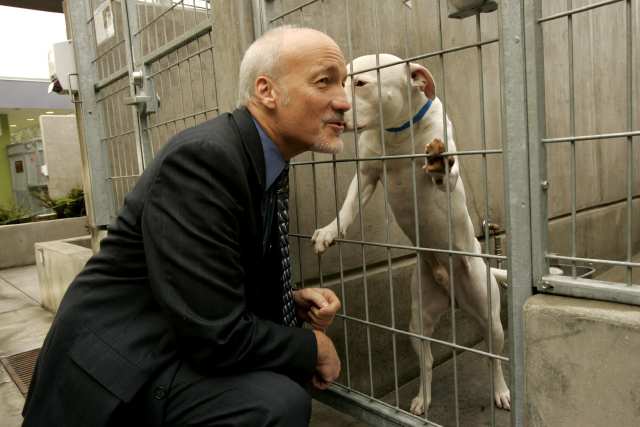
The power of a STAR Program to save lives By Ed Boks

Ed Boks and the STAR Program
Ed Boks’ Special Treatment And Recovery (STAR) Program saves Sally’s life

Local shelters and rescue organizations exist to help save the lives of lost and homeless pets who have no one else to turn to.

Sally is such a case. Sally is a 3-year-old female sharpei-chow mix, although she behaves more like a giant teddy bear.  It is difficult to understand how someone could lose such a sweet animal.  Animal Control first spotted Sally running the streets in late April.  Tried as they might, she proved elusive despite what appeared to be a broken leg.

Fortunately, persistence paid off, and Sally was finally rescued on May 3 and brought to YHS.  Unfortunately, she did indeed have a broken left hind leg. Both her tibia and fibula were broken in two.  She was also badly flea-infested. The flea infestation was easily remedied.  Not so easy to remedy was her broken leg.

To save her leg, Sally required a surgical repair that included placement of a bone plate to realign the bone fragments, immobilize the fracture and allow healing.  She also had entropion – a chronic eye condition resulting from her eyelids rolling inward.  This condition can result in ulcers and even blindness if left untreated.  Corrective surgery to her eyelids was also necessary.

These medical needs qualified Sally for our STAR (Special Treatment And Recovery) program.  STAR provides medical care to abused, neglected, injured and sick animals rescued by the Yavapai Humane Society (YHS).  Lost, homeless and abandoned pets with poor medical conditions tend to be dismissed as adoption candidates by many shelters even though these animals could be treated if only the funds were available.

Thanks to our STAR Program, funded by donations from generous supporters, YHS is able to provide animals like Sally the time and treatment they need to recover.  This is done with the help and support of local veterinarians and foster care families able to provide safe haven to an animal for the recovery period.

Sally was particularly fortunate in that she had two veterinary “champions” volunteering to help with her surgery.  YHS is thankful for and dependent on our veterinary partners.  Without their support, animals like Sally would have no chance at survival.  Our local veterinarians are truly every day heroes!

Sally’s surgery was successful saving her life.  She is now in foster care until her recovery is complete, at which time she will be available for adoption.

A local veterinarian’s compassion made Sally’s surgery possible.  But it would not have been possible without your donations to our STAR program.  If you want to help animals in distress, animals like Sally, please make sure your local shelter has a life-saving STAR Program you can help support.  Without a coordinated commpassionate community veterinarian partners and shelter volunteers, these animals would truly be hopeless.  By working together  your community can be among the safest communities in the nation for pets – owned, lost, and homeless.

Ed Boks is the executive director of the Yavapai Humane Society.

Winter weather pet tips: If it’s cold for you, it’s cold for them!

Ed Boks and dogI moved to beautiful Prescott, Arizona from sunny Los Angeles in June of last year. Being an outdoors enthusiast, I love the quality of life provided by my adopted community. However, being a Southern California boy, I was a bit unprepared for the dramatic drop in temperature. So I thought I would review for all our cold climate resident pet owners the cold weather dangers for our pets. Be aware of these cold weather safety tips for your pets:

*  Remember: If it is cold for you, it is cold for your pets, too! A common mistake people make is to assume our pets are better equipped to handle cold weather just because they are animals. They are not just animals; they are pets. They are the result of thousands of years of genetic reengineering that has left most companion animals completely dependent on our common sense.

*  Although YHS believes all pets should be kept indoors, if you must keep your dog outside for any period of time, provide a dry, draft free dog-house. It should be large enough for your dog to sit and lay down comfortably but small enough to hold his body heat. The floor should be off the ground and covered with cedar shavings or straw. Turn the shelter away from the wind, and cover the door with a waterproof burlap or heavy plastic.

*  Make sure all outside water sources don’t freeze over. Pets can’t burn the calories they need to stay warm without a fresh supply of water.

*  Be aware of salt and other ice-melting chemicals on the streets and sidewalks. They are an irritant to your pet’s paws and may cause injury if ingested. Use a warm, moist cloth to clean off any salt or chemical residues after a walk. Be the first on your block to provide your dog with a set of booties to protect his paws from these harsh and cold chemicals.

*  Check your garage and driveway for antifreeze. Antifreeze tastes sweet to your pet and most brands are poisonous. Contact your veterinarian immediately if you suspect your pet has consumed antifreeze.

*  Grooming is important; a matted coat will not protect your pet from the cold. Be watchful of ice or salt that may become entangled in long hair and remove it immediately.

*  Don’t let your pet venture onto frozen bodies of water. The ice may be too thin to support his weight and water rescues are both difficult and dangerous for the both of you.

*  Be a good kitty Samaritan and slap the hood of your car before starting it. Cats often climb next to a warm engine during the night.

*  Keep snowdrifts from piling up next to your fence, providing your pooch a way of escape. Make sure your dog is wearing a current dog license. In the event your dog does get away during this dangerous weather and YHS is able to rescue him, you will be assured of his return. If you love your pet, please license him or her.

*  If you are flying with a pet, make sure the airline provides for your pet’s safety and warmth. Some airlines restrict pets from flying when the temperature dips below a certain point. Call ahead to confirm.

Pets are part of the family; keep your family warm, and the winter months can be filled with wonderful memories. If you are looking for a pet to keep you warm this winter, come on by your local animal shelter and they will help you select your next best friend.

No-Kill Ethic gives every dog a chance by Ed Boks

Ed Boks and Xena
Behavior rehabilitation saves lives! Visit: Bound Angels for more information.

There are moments on this job that make all the heartbreak and disappointment worthwhile. Recently Sandy Nelson, who had adopted one of our shelter animals a few months ago, called me to say, “Thank you for believing Xena (pronounced Zeena) deserved a chance to live.” That was one of those moments.

When I first arrived at the Yavapai Humane Society (YHS) in July, I found Xena on the euthanasia list. Alone in her kennel, surrounded by barking dogs and abandoned by her family, she was understandably frightened. She responded to her new surroundings the only way she knew how – by demonstrating a behavior known as “fear-based aggression,” which is not uncommon in shelter dogs when they first arrive.

Although we knew she was acting out her fear, her behavior was so fearsome that our most experienced animal handlers were unable to handle her. One of them admitted that, in all his years at YHS, Xena was the only dog that actually scared him. By the time I arrived that first week in July, it had already been determined that there was no chance Xena would ever be adopted. She was marked for euthanasia.

Public safety is the primary focus when evaluating dogs for adoption. With nearly 30 years experience in animal control and welfare, I understand better than most that there are dogs who are dangerously aggressive – dogs who should never be adopted out. Was Xena such a dog?

Imagine what must go on in the mind of a dog abandoned by her guardian. You wake up as you do every morning at the foot of your master’s bed – but tonight you inexplicably find yourself alone in a cold concrete cell surrounded by excited barking dogs and strange people. Wouldn’t you lash out in fear to defend yourself?

How do you discern a truly dangerous dog from an estranged pet?

Ed Boks and Robert Cabral
Robert Cabral (Bound Angels) provides the training shelter staff and volunteers need to save the lives of behaviorally challenged dogs.

Fortunately for Xena, renowned Malibu-based dog trainer and behaviorist Robert Cabral came to the rescue. Waiving his $250 per hour fee and all the expenses he incurred from driving himself and his two dogs, Silly and Goofy, to Prescott, he came to help staff and volunteers learn his life-saving techniques.

Cabral is not your typical dog trainer. His focus is not training beloved pets how to sit and stay in your backyard. His expertise is rehabilitating behaviorally challenged shelter dogs. He has been called upon to rehabilitate dogs adjudicated as “vicious” by city magistrates – dogs most of us wouldn’t want to be in the same town with, much less on the same leash.

Believing that even these dogs deserve a chance at life is the essence of the no-kill ethic. These dogs do not come by this behavior naturally; they are trained directly or through neglect to be aggressive. The no-kill ethic asserts that every shelter animal deserves a chance at life. That means YHS will strive to treat animals in need of medical care as well as animals in need of behavioral rehabilitation in the effort to find each animal a loving home.

It was this ethic that saved Xena. The no-kill ethic created a way for the Nelsons and Xena to meet and fall in love. Today, Xena is in dog obedience classes, she happily sits for treats and she devotedly follows the Nelsons around their beautiful ranch in Chino Valley.

Cabral has a slogan: “You can’t save all the dogs in the world, but you can save one. Join the revolution.” Xena is one of many dogs benefiting from Cabral’s life-saving training. YHS staff applied what we learned and Xena responded. She overcame her fear, was removed from the euthanasia list and was adopted by the Nelsons in July.

Isn’t it time you joined the life-saving revolution? Adopt a shelter animal today.

Circle of compassion rippling through universities by Ed Boks

The New York Times recently ran an article by James Gorman on the status of animals in universities across the United States.

Historically, academia relegated animals to the province of science. Rats were confined to psychology labs; cows to veterinary barns; monkeys to neuroscience labs; and preserved frogs to the dissecting tables of undergraduates. At the same time, the attention of liberal arts and social sciences was directed solely toward human interests.

No more. This spring Harvard is offering “Humans, Animals and Cyborgs,” while Dartmouth presents “Animals and Women in Western Literature” and New York University offers “Animals, People and Those in Between.”

These courses evidence a growing interest in animal studies. In fact, anything having to do with any connection between humans and animals in art, literature, sociology, anthropology, film, theater, philosophy, and religion is fair game for animal studies.

The Animals and Society Institute, itself only six years old, lists more than 100 animal studies courses in American universities. Institutes, book series and conferences are proliferating as formal academic programs emerge.

Wesleyan University, with the Animals and Society Institute, began a summer fellowship program this year. Michigan State now allows doctoral and master’s students in different fields to concentrate their work in animal studies. At least two institutions offer undergraduate majors, and New York University is allowing undergraduates to minor in animal studies.

Scholars never actually ignored animals. Thinkers and writers of all ages grappled with human/animal issues and the treatment of animals. However, the current burst of interest is unprecedented.

Jane Desmond of the University of Illinois, a cultural anthropologist, says public sensitivities are largely responsible for all the animal attention.

The trend may be traced back to Jane Goodall, who first showed us the social and emotional side of chimpanzees in a way we could not ignore. Most recently the popular YouTube video of a New Caledonian crow bending a wire into a tool to fish food out of a container caused academics to wonder how old a child would have to be to figure that out.

The most direct influence may have come from philosophy. Peter Singer’s 1975 book “Animal Liberation” was a landmark in arguing against killing, eating and experimenting on animals. He questioned how humans could justify causing animals pain.

Lori Gruen, head of philosophy and coordinator of the summer fellowship program in animal studies at Wesleyan, said, “Thirty years ago animals were at the margins of philosophical discussions; now animals are in the center of ethical discussion.”

Another strain of philosophy, exemplified by the French writer Jacques Derrida, has had an equally strong influence. He considered the way we think of animals, and why we distance ourselves from them. In “The Animal that Therefore I Am,” he discusses not only what he thinks of his cat, but what his cat thinks of him.

What animals think is something scholars are taking more seriously. Referring to academic programs that focused on disenfranchised populations like women or African-Americans, Dr. Weil of Wesleyan said, “Unlike (those populations, animals) can’t speak or write in language the academy recognizes.” This communication deficit lent itself to academics raising moral arguments on behalf of the animals.

The great variety of subjects, methods, interests and assumptions in animal studies raises serious questions about how it all hangs together. Law schools have courses in animals and the law; veterinary schools have courses about the human connection to animals; and some courses use animals in therapy as part of animal studies.

None of this diversity diminishes the excitement in what’s going on, although there are some academics within the animal studies rubric who think the scholarly ferment has a long way to go before it can truly consider itself an academic field.

One thing the new interest in animal studies does not lack is energy. If you want to better understand what all the scholarly excitement is about visit your local shelter for your homework assignment and adopt a pet today.

Think globally; give locally By Ed Boks

Imagine how you might feel if your boss told you he was so pleased with your job performance that he gave a bonus to your coworker.  I suspect you would be dumbfounded.  Yet, in my line of work, it is not uncommon to hear, “I love the work our local Humane Society does – so I sent a gift to HSUS (Humane Society of the United States) or to the ASPCA (American Society for the Prevention of Cruelty to Animals) to support you.”

One of the greatest misunderstandings in animal welfare is the belief that HSUS and the ASPCA are affiliated with local animal welfare organizations.

Do you know how much funding HSUS and the ASPCA provide the Yavapai Humane Society each year?  If you said “nothing,” you would be correct – and this is typical for virtually every local humane society in the United States.

Ironically, HSUS and the ASPCA raise enough money each year to fund an animal shelter in every state.  However, HSUS has no animal shelter anywhere, and the ASPCA has just one shelter in New York – that actually handles fewer animals each year than most local humane societies.  The mission of these national organizations is to raise awareness of national animal welfare issues; the mission of local humane societies is to care for homeless, abused and neglected pets in their local communities.

Many mistakenly believe that gifts to national groups will trickle down to help animals in their own community. I only wish that were true.

People come to this assumption through misleading marketing tactics. Let me give you an example. Recently, the ASPCA sent a direct mail solicitation to millions of homes across the nation that said, “Together we can stop cruelty to animals. … As you read this letter, somewhere – perhaps not far from you – someone is inflicting pain on an innocent and helpless animal. … You may not be able to rescue that particular animal. … Please send the largest gift you can manage to help the ASPCA save animals like it.”

Clearly, national organizations understand that sending “the largest gift you can manage” to their New York or Washington, D.C., office is not the best way to help protect “an innocent and helpless animal,” a “particular animal,” an animal “not far” from where you live.

I have no objection to national animal welfare organizations asking for support for the wonderful work they do in calling attention to important issues. However, I do object to these organizations misrepresenting their programs by implying they are helping animals in our community. This is especially disturbing as you watch the daily barrage of heart-wrenching television ads these organizations use to seek donations.

I believe in the maxim “think globally; act locally.” However, I object to national organizations abusing this tenet by implying you are acting locally when you contribute to them. Don’t be fooled. When you contribute to these organizations, your money is leaving our community never to return. If that is your intent, fine, but be sure you understand what you are contributing to.

Every local humane society in every city, town and county, was founded to help homeless, abused and neglected animals in their own community.  Local humane societies are often governed by a local volunteer board of directors funded almost entirely by local support.

Most local humane societies receive no funding from the national groups, nor are they governed by or affiliated with HSUS or the ASPCA.  Local humane societies are often the largest local nonprofit 501(c)(3) charitable organization caring for the largest number of needy animals in your community – and these animals, our animals, need our help. They need your help.

If you are looking for the best way to help homeless, abandoned and abused animals in your community, please consider volunteering with your local shelter or making a life-saving tax-deductible donation directly to your local Humane Society.

FIV-positive cats can lead long, healthy lives by Ed Boks

Ed Boks and FIV cats
Pushkin as many good years of love to give, despite FIV

In the quest to achieve No-Kill (applying the same criteria a loving pet guardian or conscientious veterinarian would apply when deciding a shelter animal’s fate), one of the challenges we must overcome is the widespread belief in many myths regarding shelter animals.

The fact is some shelter animals have issues. Equally true is the fact that these issues are seldom the animal’s fault and they can almost always be resolved. Knowingly adopting an animal with special needs is one of the noblest acts you will ever perform; you are truly saving a life.

Let me give you an example of a myth responsible for unnecessarily killing far too many animals: “cats infected with Feline Immunodeficiency Virus (FIV) should be euthanized.” The truth is FIV cats often live long, healthy lives with no symptoms at all.

FIV is an endemic disease found in domestic cats worldwide; it is a lentivirus, meaning it progresses slowly, gradually affecting a cat’s immune system. Cats are typically infected through a serious bite, usually inflicted by a stray male cat – earning it the moniker the “fighting cat” disease (a good reason for keeping your cat indoors).

The most well-known lentivirus in humans is HIV – but there are major differences between FIV and HIV. HIV cannot infect cats and FIV cannot infect humans – in fact, there is no evidence that FIV has ever infected a human in the 6,000 years humans and cats have lived together.

The fear concerning FIV cats came to my attention recently when my shelter rescued a loving 3-year-old American shorthair named Pushkin. Pushkin was surrendered by a family not because of his disease, but because they were moving out of state and sadly could not afford to take him along. Pushkin is so sweet that my team fell in love with him and tried earnestly to find him a new home. However, when potential adopters learn Pushkin has FIV, they immediately lose interest in him.

Being the proud guardian of an FIV cat named Oliver who lives happily with my other cat, Beau Bentley, I am distressed by the apprehension I find among so many cat lovers regarding FIV.

As long as FIV cats are not exposed to diseases their immune system can’t handle, they can live relatively normal lives. When kept indoors, as all cats should, health risks are significantly reduced. FIV is not easily passed between cats either. It cannot be spread casually – in litter boxes, water or food bowls, or when snuggling and playing. It requires a serious bite to transmit the disease.

Before we knew FIV existed, shelters routinely placed these cats into loving homes where they often lived long, normal lives. With the discovery of FIV in 1986 came an undeserved stigma that has since made placing them unduly difficult.

Dr. Susan Cotter, professor of hematology and oncology at Tufts University School of Veterinary Medicine, is helping counteract these misinformed fears. “I would not advise getting rid of a cat that tests positive for FIV,” she says. “If the cat is young and healthy, it could be years before anything changes.”

Best Friends Animal Society veterinarian Dr. Virginia Clemans says “the one important thing is to keep your FIV cat healthy.”

That, of course, is good advice for all cats. In fact, the very advice we offer FIV cat owners is equally appropriate for all cats. That is, all cats should be kept as healthy as possible; kept indoors and free from stress; fed a high-quality diet; and medical problems should be treated as soon as they arise.

If you already own a cat, ask your veterinarian about early detection to help maintain your cat’s health and to help prevent the spread of this infection to other cats.

Although many FIV cats live long, happy lives, some may need periodic medical care or ongoing medical management. This is why adopting a special-needs animal is such a noble and selfless act. If you can find the room in your heart and home for a cat like Pushkin, please contact your local shelter  – because every animal counts.

The Big Fix by Ed Boks

Ed Boks and The Big FixOur motto at the Yavapai Humane Society is “Every Animal Counts.” We work hard to live up to that because we know that lost, homeless, abused and neglected animals count on YHS to intervene and reverse their plight.

Unfortunately, we can’t save them all – at least not without broad community support. Too often, and for too many animals, our limited resources become exhausted and we are forced to make the difficult decision to take the life of an animal before their time.

The good news is that euthanasia at YHS is down drastically! Following a recent change in YHS leadership and policy, the killing was reduced 42.23 percent when compared to the same period last year. Remarkably, this was accomplished despite a 3 percent increase in the number of animals taken in during this same period.

Some believe that killing shelter animals is the unavoidable by-product of providing efficient municipal services to residents. But these pragmatists might consider a state of Minnesota Legislative report, which found that for each dollar invested in spay/neuter programs, $20 in animal control costs could be saved over 10 years.

People who excuse euthanasia in shelters often say we have to be “realistic,” but such realism is best directed at the sources of the problem. Effective spay/neuter programs to assist pet owners who are poor, elderly on a fixed income, or living in remote or underserved areas is a far better use of public and private funding than catching and killing lost and homeless pets.

YHS is engaged in a quest to achieve “no-kill.” No-kill is defined as consistently applying the same criteria a loving pet owner or compassionate veterinarian would use to determine if or when to euthanize a shelter animal. That is, no healthy or treatable animal would be killed simply because of a lack of shelter space or resources.

To help orchestrate a more strategic no-kill effort, YHS is announcing a community-wide spay/neuter initiative called “The Big Fix.” The Big Fix is a program that will provide low- or no-cost spay/neuter services for pets of needy families as well as pets adopted from YHS shelters.

The Big Fix will be funded by donations and grants – and it desperately needs your help to get started. While the reduced killing over the past two months represents a good start in the right direction, we have a long way to go. Your check or online donation to YHS, with an annotation for “The Big Fix,” will help fix the problem of pet overpopulation so we can more quickly achieve No-Kill!

So where is YHS in achieving this goal today? The industry standard for calculating a community’s progress toward no-kill is determined by the number of pet deaths in local shelters annually per 1,000 human residents. The national kill rate in 2009 was 13.5. This is based on an estimated human population of 300,079,939 and 4,157,918 recorded animal deaths.

In the Southwest (Arizona, Colorado, Nevada, New Mexico and Utah), the kill rate was 15.2, based on an estimated human population of 19,048,000 and 289,530 recorded animal deaths.

Our quad-city region has an estimated human population of 110,000. With 1,892 shelter deaths in 2009, our kill rate was a staggering and unacceptable 17.25.

For years, the animal welfare community thought no-kill would be achieved when killing was reduced to 5 deaths per 1,000 residents, recognizing there will always be terminally ill and injured animals and dangerously aggressive dogs that require humane euthanasia.

However, in recent years, New York City and Los Angeles reduced their kill rates to 2 and 3.7, respectively, demonstrating we really don’t know how far we can go in this life-saving quest. And if you think things work differently in small towns or rural communities, consider the fact that Reno, Nevada, has reduced their kill rate to 5.4.

As a community, we can choose to pay the relatively modest cost to fund targeted spay/neuter programs designed to fix the problem on the front end, or we can continue to pay the ever-increasing costs of catching and killing animals on the back end. We prefer the more proactive front-end approach, and we hope you will agree by sending in a donation today for “The Big Fix,” so we can help low-income pet owners spay and neuter their pets. For more information contact me.

TNR as a Public Health response to achieving No-Kill by Ed Boks

A substantial number of animals euthanized in animal shelters each year are feral cats and their neonate offspring.  A program to control the homeless cat population by neutering instead of culling cats in shelters is critical to achieving No-Kill.

Overpopulation must be curtailed at its source.  Sterilization is the only humane, non-lethal solution to unchecked reproduction.  TNR (Trap/Neuter/Return) is designed to achieve this goal by reducing the stray and feral cat population through attrition by trapping, sterilizing, and inoculating feral and stray cats against distemper and rabies, and then returning them to their already established territory, where they are monitored by feral cat colony managers. The sterilization prevents the cats from reproducing while inoculations prevent disease.  Ear-notching provides an easy way to identify cats in a TNR program.TNR has a history in Denmark, England, Israel, and the United States.  It is endorsed by the American Veterinary Medical Association and is currently being implemented with local governments’ approval in many communities. Humane organizations endorsing TNR include the Humane Society of the United States, Friends of Animals, Alley Cat Allies, Best Friends Animal Society in Utah, Tufts Center for Animals and Public Policy, the Association of Veterinarians for Animal Rights (AVAR) and the Cat Fanciers’ Association. A national opinion poll conducted by Alley Cat Allies in May 2003 found that out of 24,599 respondents, 94% supported TNR as an effective tool in addressing feral and stray cat population.  Since March 2002, the Journal of the American Veterinary Medical Association has published four articles in favor of TNR.

TNR has proven to be an effective and workable program for long-term population control and is increasingly being utilized by public and private entities to address feral cat populations and the concomitant problems of protecting the public health from rabies and cat nuisance complaints.  It has been demonstrated to reduce over populations, complaints about roaming and the number of cats in shelters in communities in the United States and abroad.  It reduces euthanasia rates, and costs less than half of the cost of traditional trap and kill programs.  Dr. Julie Levy, DVM, Ph.D., monitored an eleven-year TNR project that involved eleven feral cat colonies on a central Florida campus.  Dr. Levy concluded that “a comprehensive long-term program of neutering followed by adoption or return to the resident colony can result in reduction of the free roaming cat population in urban areas.”

TNR is working successfully in New Jersey in model TNR programs in Cape May, Atlantic City (at the Boardwalk), Phillipsburg and Bloomfield.  In addition, support for TNR was one of the top three recommendations of New Jerseyans in comments received at public hearings on the topic.

Elsewhere in the country, the Orange County, Florida, Animal Services Department, the San Francisco SPCA, and statewide programs in California and Utah have successfully implemented TNR programs.  Maricopa County, Arizona and correctional institutions in Ohio, Montana and New York State have also officially approved TNR as a means to feline population control. These programs are additionally beneficial to local governments, as volunteers can often be found to assist municipalities in managing feral cat colonies but are generally not willing to assist in trapping and removing cats for euthanasia.

Examples of successful TNR programs include:

Alachua County, Florida: A program called Catnip was implemented in 1998 and is responsible for sterilizing more than 22,000 cats since then. The program decreased shelter intake of cats by 61% since 2000.

Maricopa County, Arizona: Ed Boks, former Director of Animal Care and Control, Maricopa County, Arizona, studied conventional methods of feral cat control for over 20 years. He determined that these methods do not properly regulate the population and, consequently, initiated a TNR program that is operated by the county animal control department. Within eight years the euthanasia rate dropped from 23 cats per 1,000 county residents to only eight cats per 1,000 county residents.

Orange County, Florida: Orange County, Florida has a population of 700,000 people. Its animal control department incurs costs of approximately $105 per animal when it must respond to a complaint and impound and euthanize the animal. Before its TNR program was introduced, there were approximately two hundred complaints per year, resulting in as many animals being captured, with a cost of $21,000 to the county. Within six years after the introduction of TNR by animal control services in 1995, complaints decreased by approximately 10% as did the number of impoundments, with a total savings to animal services of over $100,000. Within the six years of the start of the program, euthanasia decreased by 18%.

San Diego, California: Founded in 1992 by Dr. Rochelle Brinton, the Feral Cat Coalition (FCC) introduced TNR to San Diego on a countywide basis. FCC is an all volunteer organization that provides free sterilization procedures for feral and stray cats. In addition to sterilization procedures, the cats are vaccinated for rabies and treated for fleas and any immediate medical problems. FCC volunteers monitor the feral cats after they are returned to the outdoors. The local animal control departments support the program as it has had a positive impact in reducing the feral population, thus reducing the number of cases to which they would have otherwise been required to respond. By 1994, two years after the start of the TNR program, the total number of cats brought into San Diego shelters dropped over 34% and the euthanasia rates in county shelters for all cats dropped 40% (instead of the usual 10% increase). San Diego euthanized 8.0 shelter animals per 1,000 people in 1997; 4.9 in 2002. The reduction in the euthanasia rate translated to an estimated tax savings of $795,976.

San Francisco, California: The San Francisco SPCA initiated a citywide TNR program in 1993. The SPCA has been working with feral cat caregivers to control the feral cat population, provide some medical care, keep the cats adequately fed and, when possible, adopt them into homes. There are three aspects to the program. The first is “feral fix,” a program through which the SF/SPCA provides vaccinations and spay/neuter surgery for San Francisco feral cats, all at no charge to their caregivers. Since the program began they report altering over 10,000 cats. The second aspect of the program is “Cat Assistance Teams.” In neighborhoods throughout the City, CAT members work together to humanely trap feral cats, transport them to Feral Fix, provide post-surgery recovery care, and socialize feral kittens before placing them in homes. CAT members also provide expert advice and assistance to novice caregivers in their neighborhoods. Finally, there is 9 Lives™ Humane Feral Cat Management Video Series including nine comprehensive videos that cover all aspects of caring for feral cats. Within six years of commencing the TNR program, euthanasia rates dropped 70%.

New York City, NY: The New York City Feral Cat Council (“NYCFCC”) is a coalition of NYC animal groups working to humanely reduce the City’s feral cat population through the use of TNR. They established a TNR program on the Upper West Side of Manhattan in 1999. Based on statistics compiled by New York City’s Animal Care and Control, the number of stray cat intakes from the Upper West Side was reduced 73% in the first three years of the program. During the first year of the program, there was a 59% reduction in the number of cats arriving in shelters.

Cape May, New Jersey: In 1995, John Queenan, with the Cape May City Animal Control, proposed an ordinance to facilitate TNR and the feeding of feral cat colonies. Queenan based his proposal on similar regulations in Santa Cruz County, California. Because pick-up and euthanasia had not resolved the city’s overpopulation problem, the ordinance focused on preventing reproduction. As a result of Cape May’s ordinance change, 200 cats were altered in 1997. Based on the number of nuisance complaints, litters of kittens and visual sightings of the colonies, it is estimated that the feral cat population, which was between 500 and 800 cats in 1994, has been reduced by 50%.

Atlantic City, New Jersey: The Humane Society of Atlantic County, in conjunction with the Health Department of Atlantic City and local volunteers, has used TNR successfully and with municipal approval. Through kitten adoptions and natural attrition (since these cats no longer reproduce), the feral cat population under the Atlantic City boardwalk was reduced by more than 70% within three years. Cat related nuisance complaints, common before enactment of the TNR ordinance, are now rare.

Phillipsburg, New Jersey: Phillipsburg, Warren County also authorized TNR. Dr. Robert Blease, a veterinarian and founder of Common Sense for Animals (“CSA”), a non-profit organization that receives no public funding, initiated the municipality’s TNR ordinance in 2001. All feral cats that are brought to CSA are vaccinated, sterilized, and identified by way if ear notching. Cats that are infected with FIV/FEHV, unhealthy or vicious, are humanely euthanized. Since Phillipsburg authorized TNR the stray cat population has reportedly dropped an estimated 350 cats in the first year alone, and citizen complaints about stray cats have dropped to zero.

Bloomfield, New Jersey: The Friends of the Bloomfield/Bukowski Animal Shelter (FOBAS) initiated a TNR program September 2003 with two colonies. The program has been endorsed and supported by the mayor, the town council and the Bloomfield Department of Health. Neighborhood Cats, a New York City-based volunteer non-profit organization, provides advice and assistance to the town, which adopted TNR as its official feral cat program.

For information on the sources for the above information as well as how to calculate the feral cat population in your community refer to Analysis of Feral Cat Solutions.

Nathan Winograd’s deceptive attacks obfuscate facts by Ed Boks

Ed Boks and Nathan Winograd
Nathan Winograd shoots his arrows and then paints a target around them. 

Recently Nathan Winograd mischaracterized a portion of an email from me as suggesting LA’s  spay/neuter law is a failure. This is typical of the divisive sniping endemic in all of Nathan’s self-aggrandizing philosophy.

The email quotes a portion of an email that says, “we can’t hide from the fact that veterinarians are raising their prices to a point where people cannot afford the services regardless of vouchers or financial assistance. We need some innovative thinking in addition to more mobile vans.” Continue reading “Nathan Winograd’s deceptive attacks obfuscate facts by Ed Boks”

To declaw or not to declaw by Ed Boks

I have been asked to explain my comments at a recent Santa Monica City Council meeting. The Council was deliberating over whether or not to enact a Ban against Cat Declawing within the city limits of Santa Monica. A similar measure was defeated in Malibu two weeks earlier.

My position is a difficult one, but an honest one and I think my comments speak for themselves. I don’t stand alone in my position, it is shared by the San Francisco SPCA who released the following statement, “Our mission is to save animals’ lives and we understand that, in some instances, [declawing] may be the only way to prevent abandonment, relinquishment, or euthanasia.”

The San Francisco SPCA issued the above statement denouncing San Francisco’s move to ban declaws even though the group advocates against the procedure. Being against a Ban is NOT being for declawing. I share the SF SPCA’s concern that frustrated owners with no option to declaw cats will be forced to decide to abandon or relinquish their pet.

Keep it legal, keep it rare” is the position of virtually every national animal welfare and veterinary association. It is also the position of most shelters committed to reducing the number of animals killed in their communities. The suggestion that most European countries have already enacted a ban is disingenuous.

The Los Angeles Chief Legislative Analyst Report to the LA City Council busted three myths propagated by Ban Proponents. He found that declawing is “not cruel” (a position I am not prepared to take). He found that declawed cats relinquished to LA shelters are “a rarity”. And he called into question the City’s authority to oversee the practice of veterinary medicine, and said that even if the City has this authority, it does not have the resources or staff to do so.

To further clarify my “last resort”, and I do mean LAST RESORT position, I am sharing my comments from the recent Santa Monica City Council meeting to help explain and support my position. Again, I do NOT support declawing, however, I don’t support a Ban either because of the unintended consequences that are sure to follow:

“Good evening. My name is Ed Boks and I am here as an animal welfare advocate with nearly 30 years experience in animal care and control and over 12 years experience managing three of the largest animal shelter systems in the United States, including New York City and Los Angeles. As an experienced shelter manager, I can tell you that an uncompromising ban on cat declawing in the City of Santa Monica will result in more cats abandoned on your streets and more cats relinquished and killed in your shelter.

Like Ban Proponents, I abhor the practice of Declawing, but I abhor the abandoning, relinquishing and killing of cats even more, and I’m here to tell you that is what a Ban will lead to.

It is interesting that you are told that Declawing is mutilation by the same people who embrace other forms of mutilation! Some Ban Proponents approve cutting the tip off the ear of otherwise healthy feral cats for the convenience of being able to identify them in a colony.

Other Ban Proponents promote invasive surgery for the convenience of reducing dog and cat populations; another form of mutilation in the minds of some.

And probably everyone in this room, on both sides of this debate will agree that these forms of “mutilation” are acceptable. Why? Because we know they save lives!

In the same way, when a veterinarian performs a declaw surgery as a last resort she is saving a life! You take that life-saving option away from a cat guardian and you will force them to relinquish their pets to a shelter, who, at a cost to the City, will try to re-home them, and if they can’t – these cats will be killed. Why, when we are all trying so hard to end the killing in our shelters, would we want to create another reason to kill?

In Malibu, Mayor Stern voted against a Ban explaining that he would have taken his cat to the Pound if he couldn’t have her declawed because his wife’s health is at serious risk to a cat scratch. Thank God he had this option!

Please don’t limit the life-saving tools available to licensed veterinarians or second guess their professional judgment.

When performed as a last resort, declawing is a life saving remedy that keeps cats and people together, cats who might otherwise be subject to abuse, abandonment, or death.

Please vote NO to a Ban. A No Vote is a life saving vote. Thank you.”