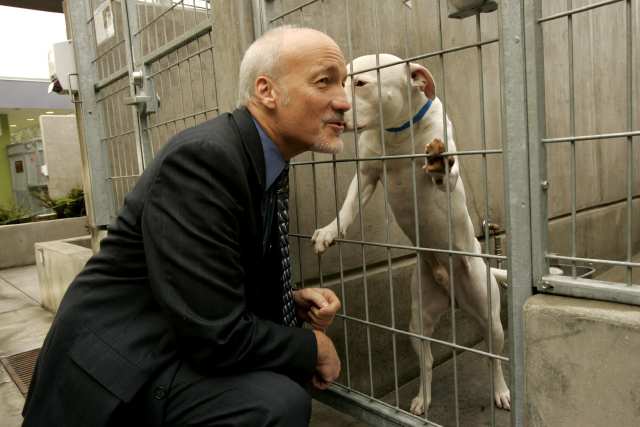
Fundraiser honors pets that ‘reign’ in our hearts by Ed Boks

To get a message across, the Yavapai Humane Society (YHS) often uses a play on words – a clever or witty use of language. For instance, on Saturday, Sept. 8, YHS is celebrating its 40th anniversary at the Prescott Resort and the event is called Reigning Cats & Dogs.

The name Reigning Cats & Dogs is an attempt to humorously convey the role our pets play in our lives. In many ways, and for many of us, our pets take on a central, or if you will, a “reigning” role in our lives. It is in this fun spirit that we are inviting animal lovers to a royal celebration of the relationship we share with our pets.

The phrase “Reigning Cats & Dogs” is a homophone of the term “raining cats and dogs.”

It is ironic, even tragic, that in a community that celebrates Reigning Cats & Dogs we can at the same time experience a raining cats and dogs resulting in an overflow of lost and unwanted pets at YHS.

So dire is the current situation that YHS is announcing a state of emergency. The crisis was caused by the recent monsoon. Dogs frightened by thunder are escaping from their homes in record numbers – and most are found without a dog license, identification tag or microchip. Worse, pet owners are not coming to YHS to identify their lost pet in a timely manner. This is costly to both YHS and the frantic pet owner. Our concern is pet owners may not know YHS is the central location where all lost pets are taken by local animal control and Good Samaritans who rescue lost pets off the street.

When you lose your pet, please visit the YHS Lost & Found Pet Center every three days at least – and more often when possible. If your pet does not have a microchip, you can purchase one at the YHS Wellness Clinic on any Friday or at the YHS Lost & Found Pet Center Monday through Friday. In the effort to reunite more lost pets with their owners, YHS is offering microchips for just $20. A microchip will help reunite you with your lost pet in the shortest amount of time.

YHS is also launching a month long Raining Cats & Dogs Adoptathon. From today through the end of September all dogs and puppies are just $25 and all cats and kittens are “pick your price.” Every adoption includes spay/neuter surgery, vaccinations and a microchip. This is over a $400 value per adoption. If you are considering adding a pet to your family, now is the time. YHS has the largest selection of quality pets available for adoption at the most affordable prices. When you adopt a pet from YHS you are saving two lives; the one you adopt and the one your adoption makes room for.

Another way you can help YHS is by participating in the Reigning Cats & Dogs Auction which is open online until Thursday, Sept. 6. Auction items range from exotic vacation getaways to having your pet featured in the inaugural 2013 Yava-Paw Calendar. So, tell your friends, family, community and let the bidding begin!  You can purchase your tickets to the Reigning Cats & Dogs Gala scheduled for Saturday, Sept. 8, at the Prescott Resort. All proceeds go to help fund YHS’ many life saving programs. I hope to see you there!

Support local animals in need through gala, raffle, thrift store by Ed Boks

If you’re an animal lover, you’re invited to celebrate the Yavapai Humane Society’s 40th anniversary at this year’s Reigning Cats & Dogs Dinner Gala and Silent Auction. The gala is scheduled for Saturday evening, Sept. 8, at the Prescott Resort. Tickets are $100 each, or $900 for a table for 10. I look forward to seeing you there!

Raffle tickets for the Reigning Cats & Dogs Grand Prize are also available. Imagine winning a three-night stay at the AAA Four Diamond award-winning El Monte Sagrado Resort in Taos, N.M. The resort was featured in Travel and Leisure and Condé Nast Traveler, and is on their elite Gold List. With sunlit fish-filled streams, tropical flora and the sounds of calming waterfalls, the nurturing effects begin the moment you arrive. Should you opt for a winter visit, a ski shuttle runs daily to Taos Ski Valley. El Monte Sagrado ensures a level of personalized pampering you won’t soon forget. For more information on the resort or to purchase raffle tickets, visit the YHS Thrift Shop or Spay/Neuter Clinic. You do not have to be present to win. Only 2,000 tickets will be sold at $5 each, or five for $20.

YHS has new hours: YHS is now open 11 a.m. to 5 p.m. Monday through Saturday and 11 a.m. to 3 p.m. Sunday. It is closed on Tuesdays.

Adoption Special: YHS is promoting an adoption special on all Certified Pre-Owned Cats! That’s right, $0 down; $0 financing; and no payments EVER! Nose to tail, multi-point inspection and catjack (microchip) included. (Testing fees apply.) This means all cats and kittens are available for the price you pick. This is a $400 value (including spay/neuter surgery, microchip, vaccinations, etc.) for the price you can afford.

Microchips: This is the busiest time of the year for YHS. With the rodeo, parades, fireworks and thunderstorms, we rescue more terrified lost pets than any other time of the year. Getting your lost pet back to you quickly and safely is our highest priority. To do this better YHS has lowered the price of a microchip to $20. You can have your pet microchipped from 11 a.m. to 5 p.m. Monday through Friday at the YHS Lost & Found Pet Center, 1625 Sundog Ranch Road, Prescott Valley, or any Friday at the YHS Spay/Neuter and Wellness Clinic located at 2989 Centerpointe East in Prescott. Don’t delay, protect your pet today!

Spay/Neuter Special: Are you looking to save your furniture from scratches and snags? Get a free nail trim for your pet cat at the time you schedule a spay/neuter surgery for him/her. Just mention this offer when you call to schedule your appointment.

Thrifter Alert: Have you been by the YHS Thrift Shop lately? Come by to see our new look, lower prices and great bargains. All this for a great cause to help fund our life-saving programs!

From clothing and household items to jewelry and more, the YHS Thrift Shop is loaded with great deals for every bargain hound! If you’re moving, downsizing or just cleaning, please consider donating to YHS Thrift Shop. We respectfully request donated items be sell-able and in good condition. When you drop off your donations, take a moment to shop our fine collectibles, jewelry, antiques and other treasures. If needed, we do fetch large items.

Much to celebrate at the Yavapai Humane Society by Ed Boks

The Yavapai Humane Society (YHS) is celebrating its 40th anniversary this year. I launched the year with a column explaining how wonderful it would be if YHS could celebrate this milestone year with a new X-ray machine.

Thanks to the generosity of several individuals and a significant gift from a foundation wishing to remain anonymous, YHS was able to purchase this life-saving equipment. I want to publicly thank all those who made this miracle a reality!

An X-ray machine significantly enhances YHS’s ability to diagnose and treat critical-needs animals more efficiently and humanely – resulting in more lives saved. The X-ray machine helps ensure every critically injured or severely ill animal YHS rescues has a fighting chance at a quality life.

Now that YHS has this wonderful tool, I am making a special plea for donations to our Special Treatment and Recovery (STAR) fund. Donations to the STAR program provide funds to care for the medical needs of animals that might be euthanized otherwise. The STAR fund is where we go when we need special medicines, X-rays, medical tests and reconstructive surgeries that our budget just can’t support.

Through the STAR program the entire community can participate in making sure injured and sick animals receive the care they need. Please consider making a contribution to this special program.

Speaking of our 40th anniversary celebration, be sure to save the date for this year’s Reigning Cats & Dogs Dinner and Auction Gala on Saturday evening, Sept. 8, at the Prescott Resort.

A special feature this year is the 40th anniversary essay contest called “40 Years of Saving Lives, 40 Years of Memories.”

You are invited to share your personal heart-warming animal story in the form of an essay (500 words or less), poem, song, video or photograph. Humorous or heart-tugging entries with a direct association with YHS are welcomed. Entries are limited to three. Entries will be submitted to the judges anonymously, making the contest open to all, including volunteers and former and current employees. There are no age limitations.

The grand prize is two tickets to the Reigning Cats & Dogs Gala where the winning entry will be recognized ($200 value).

The first runner-up will win a certificate for a free spay or neuter surgery for a family pet or a friend’s pet at the YHS Spay/Neuter and Wellness Clinic (up to $100 value). The second runner-up will win a $25 gift certificate to the YHS Thrift Shop. All winners and honorable mentions will be featured on the YHS website.

Entry deadline is Sunday, Aug. 12, 2012; winner notification is Friday, Aug. 17, 2012. Be sure to include your name, address, phone number and email address. By submitting your entry, you permit YHS to reproduce it on the YHS website and other media.


Feline Immunodeficiency Virus nothing to fear by Ed Boks

Ed Boks and black cat
FIV is responsible for the unnecessary killing of far too many cats in way too many animal shelters; and that is not right, because FIV cats often live long, healthy lives with few to no symptoms.

This week I want to feature Portia, a 4-year-old domestic short hair with a spice for life; described by those who know her as cool, calm, confident, playful and a joy to be around. She is mellow enough to get along with a cat-savvy dog and respectful children.

Portia has had many suitors in her two months in the shelter, but potential adopters quickly lost interest when they learned she has feline immunodeficiency virus (FIV). Continue reading “Feline Immunodeficiency Virus nothing to fear by Ed Boks”

Botox removes wrinkles… and animal testing! by Ed Boks

Ed Boks and animal testing
Six states have passed Rescue + Freedom Project’s Beagle Freedom Bill, which requires laboratories to offer healthy dogs and cats for public adoption after the experiments have ended. Click on link to see how you can help!

I’ve never met a person willing to admit a tolerance for animal cruelty. However, animal cruelty is quietly accepted by most of us.  Case in point: The government requires every new compound that you might be exposed to – whether it’s the latest wonder drug, lipstick shade, pesticide or food dye – to be tested to make sure it isn’t toxic. This testing usually results in a torturous life and death for many lab animals.

When it comes to corporate budget sheets, saving animals can seem a minor concern. One exception to that mindset is Allergan Inc. of Irvine, Calif., the manufacturer of Botox. Allergan announced last June that the Food and Drug Administration (FDA) approved its new method to test Botox’s potency. Instead of testing every batch on live animals, Allergan can now run a test on cells in a lab dish. Continue reading “Botox removes wrinkles… and animal testing! by Ed Boks”

Animal abuser registries would protect all of us By Ed Boks

Sex offender registration is a system designed to allow authorities to track the residence and activities of sex offenders. Information in the registry is made available to the public via a website or other means. In many jurisdictions registered sex offenders are subject to restrictions including housing, being in the presence of minors, and living in proximity to a school or day care center.

Efforts are now underway to expand this concept to include animal abusers. Initiatives are gaining support and legislation has been introduced in at least five states, including Arizona.

The Arizona Animal Cruelty Registry Law (HB 2310) would require people convicted of animal torture, mutilation, intentional killings and animal fighting to register with the police and provide an array of personal information along with a current photograph, much like sexual predators. The information, along with the registrants’ specific offense, would be posted on the Internet.

Animal welfare activists hope laws like this will inspire governments nationwide in the same way Megan’s Law registries for child molesters have proliferated in the past decade.

In Florida, State Senator Mike Fasano proposed Dexter’s law, named after a kitten beaten to death in his state. His proposal would require convicted animal abusers to register with authorities. Their names, home addresses and photographs would be posted online, and they would pay $50 a year to maintain the registry.

Registries have also been proposed in Colorado, Maryland and New York and similar proposals are expected in other states.

Suffolk County on Long Island moved to create a registry in 2010, and has since been followed by two other New York counties. No names appear on the Suffolk County registry yet, because it was only recently set up. Convicted abusers will appear on the registry for five years. Those failing to register are subject to a $1,000 fine and up to a year in jail.

The New York counties require pet stores and animal shelters to check the names of anyone seeking to adopt or buy an animal against the registry.

Maryland State Senator Ronald Young said he plans to introduce legislation in the wake of two incidents in his state. In one, a Yorkshire terrier was thrown off a 23-foot-high balcony; the dog, Louie, survived. In the other, a golden retriever puppy named Heidi was shot to death.

A bill to create a registry in California, introduced in 2010, didn’t make it through the Legislature, partly because of concerns about its cost.

Liberty Watch Colorado, an advocacy organization committed to holding elected officials accountable, says such legislation is “an unnecessary expansion of government.’

However, the Animal Legal Defense Fund, an animal rights law organization based in California, outlines some taxpayer benefits. For instance, well-managed registries can reduce the number of abused animals and the animal control costs associated with caring for and treating abused animals. They also serve as an early warning system for potentially violent criminals like Ted Bundy, David Berkowitz and Jeffrey Dahmer all of whom tortured and killed animals during their childhoods.

“Researchers as well as FBI and other law enforcement agencies nationwide have linked animal cruelty to domestic violence, child abuse, serial killings and the recent rash of killings by school age children,” says Dr. Randall Lockwood, vice president of training for the Humane Society of the United States.

Albert Schweitzer said it best when he warned that “Anyone who has accustomed himself to regard the life of any living creature as worthless is in danger of arriving also at the idea of worthless human lives.” Registering felony animal abusers not only helps protect innocent animals, it helps protect our families, friends and neighborhoods.

Children’s moral development influenced by adopting a pet by Ed Boks

Ed Boks and Pia Salk
Dr. Pia Salk,Psychologist, Writer, Spokesperson, Animal Advocate

Psychologist, animal welfare advocate and human-animal bond expert Dr. Pia Salk is a regular contributor to Martha Stewart’s The Daily Wag. In a recent article, Salk asked the provocative question, “Can adopting a shelter animal make a difference in your child’s moral development?”

Salk offers important insight into the values we teach our children when we adopt a companion animal from a shelter. According to Salk, the very decision to devote family resources to caring for an animal in need sends a clear message to your children about who you are and what you stand for.

When you adopt a shelter pet, Salk explains, children internalize important values – “We are a family that uses the power of choice to save a life.” This teaches kids that by taking personal responsibility, their choices can affect the larger community.

Children need to feel they can impact their world. Parents need to give children opportunities to do so in positive, pro-social ways. Adopting and caring for an animal can provide this opportunity.

Where should this life lesson begin? Salk suggests a family meeting to discuss if the family is willing and able to meet an animal’s needs. Together, a family should explore every facet of these questions, such as: Do we need landlord permission? How much exercise will the animal need? How will we provide medical care? Who will be responsible for feeding, training and walks? Who will care for the animal during vacations? How will a pet affect plans to move? Such conversations teach the importance of planning, navigating around potential obstacles and committing to a goal, for better or worse. This exercise is an important step in teaching children the inherent value of the animal’s life and well-being.

Answering these questions will also help you determine what sort of animal is a good match for your family. Don’t hesitate to ask your local shelter for help in making this decision.

The choice around which animal to adopt can lead to deeper discussions about family values. Perhaps your family is willing to provide a home to an older pet abandoned because of an eviction, or maybe to a cat who has lost an eye or a limb. These choices help children see past age and physical “limitations” so they appreciate another being’s intrinsic worth. This teaches acceptance and gives children a chance to witness the inspiring resilience of animals.

Perhaps your family is willing to take in a breed disadvantaged by negative stereotypes. This teaches kids to learn for themselves and not be influenced by a biased or misinformed public perception.

For kids who are adopted, adopting a pet provides an opportunity to talk about their feelings while learning more about their family’s love and compassion for others in need. Likewise, for a child who is hearing-impaired or has a condition such as diabetes, adopting an animal with a similar condition, or other special need (provided the resources exist to properly manage it), can be therapeutic and enriching for all involved.

“There is no limit to the great lessons you can teach your children when you opt to adopt,” says Salk. “These lessons benefit everyone involved and they live on in the minds of children, manifesting in a lifetime of compassionate acts.”

What better time to have this compassionate, life-saving family discussion?  Visit your local shelter today to see all the pets waiting for the perfect home – yours.

Euthanasia not acceptable for healthy or treatable pets by Ed Boks

The mayor of Los Angeles once told me that he considered managing animal shelters more difficult than running a metropolis like L.A. I had to agree. Animal shelters represent the worst – or best – in a community. They are a nexus of heartache and compassion. When one of these outweighs the other, the soul of a community is revealed.

Understanding the daily challenges inherent in managing animal shelters, my heart goes out to the Arizona Humane Society (AHS). AHS is caught up in a public relations nightmare involving a homeless man who brought his kitten to them for medical care. Daniel Dockery, 49 years old, had hand-raised a 9-month old kitten since she was born. Dockery attributed his companionship with the kitten, Scruffy, to his ability to stay off heroin.

When Scruffy suffered “non-life threatening injuries,” Dockery rushed her to AHS where a medical examination determined it would cost $400 to treat her. Unable to pay the fee, Dockery surrendered the kitten to AHS after being assured she would be treated and placed in foster care. Several hours later, Scruffy was euthanized. The report of her death went viral. It seemed every national mainstream and alternate news source reported on Scruffy’s untimely death. The resulting outrage forced AHS to hire a publicist to help alleviate public ire.

The publicist explained that Dockery’s lack of funds combined with the number of animals in need of urgent care led to the decision to euthanize Scruffy. The betrayal of trust left Dockery feeling responsible for Scruffy’s death and prompted an angry public to threaten withholding funds from AHS.

One positive outcome from this ordeal is that AHS created an account funded by donations to cover the cost of emergency animal care. The account is similar to the Yavapai Humane Society’s STAR (Special Treatment And Recovery) fund, which is funded by donations and is responsible for saving the lives of many homeless animals in need of critical care.

Having been involved in animal shelter management for 30 years, I understand that mistakes can be made. I have also learned that policies and procedures can be implemented to help ensure errors are made on the side of saving a life, not taking it.

I share this lamentable story because it sits in juxtaposition to many life and death decisions made by the Yavapai Humane Society. For instance, in recent weeks YHS took in four senior pets, each surrendered by their respective owner claiming the pet was suffering from a life threatening illness.

While YHS provides euthanasia to owned animals who are irremediably suffering, we make it clear to pet owners that we will not euthanize an animal when it is determined that the animal is not suffering, is actually healthy, or can be treated.

In each of these cases, after ownership was legally surrendered to YHS, medical examinations were performed. A consultation with the private veterinarian handling the healthcare of each animal prior to surrender was conducted when possible. In each case no life threatening condition or suffering could be found. These animals have since been placed for adoption in hope they will live their remaining years in a loving home.

Every day employees at animal shelters across the United States are faced with decisions to kill or not to kill. Whether it is killing an animal too quickly or not quickly enough, shelters often find they are damned if they do or damned if they don’t.

If the Yavapai Humane Society is to be judged, let it always be for trying to save the lives of animals others have given up on. Since embracing our “no-kill ethic,” the Yavapai Humane Society has reduced shelter killing 77 percent – making our community the safest for pets in all Arizona.

If you are able to help YHS sustain this life-saving mission (regardless of age) please make a tax-deductible donation to the Yavapai Humane Society today.

Woman sues to prove animals are ‘living souls,’ not property by Ed Boks

“Today Show” contributor Scott Stump recently reported on a New Yorker named Elena Zakharova who filed a civil suit in a New York court against an Upper East Side pet store. The store, Raising Rover, sold Zakharova a puppy that developed numerous medical complications. The suit seeks to hold the store liable for the dog’s pain and suffering, and medical bills, as if the dog were a person rather than an inanimate product.

New York law considers pets “property,’ but the complaint wants to change that definition. The goal is to help shut down puppy mills that often mass-produce animals sold in boutique pet stores like Raising Rover, where “Umka” was purchased.

“Umka is a living soul,’ the suit reads. ” She feels love and pain.’

Ownership of Raising Rover has changed since Zakharova purchased Umka.

“I know nothing about the sale. The prior owner has the records. We are careful about where we get our puppies,” Raising Rover’s new owner Ben Logan told the New York Daily News. Logan declined to provide information about the prior owner.

Zakharova is seeking compensation for surgeries and medical treatment for Umka totaling about $8,000. She also wants a full return of the dog’s sale price plus interest since the date of purchase in February 2011. Zakharova intends to donate any award to an animal charity, Lask said.

New York state has a “Puppy Lemon Law’ that allows buyers to return sick animals to a pet store within 14 days for a full refund. The law is meant to slow puppy mills’ mass production of dogs with inherent medical problems. However, Umka’s medical issues did not become apparent for months after Zakharova purchased the dog.

“The Puppy Lemon Law doesn’t cut it,’ Lask said.

If the definition of a pet is changed from property to a sentient being, it could substantially change the amount of damages awarded when an owner buys a defective dog born in a puppy mill. That could have a chilling effect on pet stores buying animals from puppy mills fearing large payouts from lawsuits.

“It’s going to put a number on my dog’s broken hips that you created because you’re negligent, you’re greedy, and you’re mass-producing puppies,’ Lask said. “Right now, even if you return it, they just kill it, which is so inhumane.’

Lask is an animal lover who owns a Chihuahua named Lincoln who was found to have a hole in his skull months after her purchase. That discovery led her to investigate the practices of puppy mills. She waited six years to find a case to help correct the larger issue.

“It’s much bigger than this case,’ she said. “I am looking to shut down the puppy mill world.’

The main issue will be proving to a judge that pets are living souls who experience feelings of pain and emotion. “Human beings have treated other humans as property in history before recognizing it was wrong,” said Lask, “so it’s not too much of a stretch to ask the courts to change the definition.”

“It’s already a felony to abuse an animal. If animals have criminal rights, why not put rights on a damaged leg or a heart condition? If we’re not equating (an animal) to a human being, and we’re not equating it to a table, there has to be something in the middle.’

The suit brings to light the practices of puppy mills and their damaging effects on animals and their human owners. A 2011 investigation by The Humane Society of the United States revealed that Raising Rover, where Umka was purchased, was one of 11 upscale pet stores that purchased animals from Midwestern puppy mills with horrendous conditions.

The moral of the story is buyer beware! Experts agree consumers should opt to adopt from shelters to avoid the trauma that comes from paying exorbitant fees for pet store animals with hidden defects.

The power of a STAR Program to save lives By Ed Boks

Ed Boks and the STAR Program
Ed Boks’ Special Treatment And Recovery (STAR) Program saves Sally’s life

Local shelters and rescue organizations exist to help save the lives of lost and homeless pets who have no one else to turn to.

Sally is such a case. Sally is a 3-year-old female sharpei-chow mix, although she behaves more like a giant teddy bear.  It is difficult to understand how someone could lose such a sweet animal.  Animal Control first spotted Sally running the streets in late April.  Tried as they might, she proved elusive despite what appeared to be a broken leg.

Fortunately, persistence paid off, and Sally was finally rescued on May 3 and brought to YHS.  Unfortunately, she did indeed have a broken left hind leg. Both her tibia and fibula were broken in two.  She was also badly flea-infested. The flea infestation was easily remedied.  Not so easy to remedy was her broken leg.

To save her leg, Sally required a surgical repair that included placement of a bone plate to realign the bone fragments, immobilize the fracture and allow healing.  She also had entropion – a chronic eye condition resulting from her eyelids rolling inward.  This condition can result in ulcers and even blindness if left untreated.  Corrective surgery to her eyelids was also necessary.

These medical needs qualified Sally for our STAR (Special Treatment And Recovery) program.  STAR provides medical care to abused, neglected, injured and sick animals rescued by the Yavapai Humane Society (YHS).  Lost, homeless and abandoned pets with poor medical conditions tend to be dismissed as adoption candidates by many shelters even though these animals could be treated if only the funds were available.

Thanks to our STAR Program, funded by donations from generous supporters, YHS is able to provide animals like Sally the time and treatment they need to recover.  This is done with the help and support of local veterinarians and foster care families able to provide safe haven to an animal for the recovery period.

Sally was particularly fortunate in that she had two veterinary “champions” volunteering to help with her surgery.  YHS is thankful for and dependent on our veterinary partners.  Without their support, animals like Sally would have no chance at survival.  Our local veterinarians are truly every day heroes!

Sally’s surgery was successful saving her life.  She is now in foster care until her recovery is complete, at which time she will be available for adoption.

A local veterinarian’s compassion made Sally’s surgery possible.  But it would not have been possible without your donations to our STAR program.  If you want to help animals in distress, animals like Sally, please make sure your local shelter has a life-saving STAR Program you can help support.  Without a coordinated commpassionate community veterinarian partners and shelter volunteers, these animals would truly be hopeless.  By working together  your community can be among the safest communities in the nation for pets – owned, lost, and homeless.

Ed Boks is the executive director of the Yavapai Humane Society.