 In the ever-evolving landscape of animal welfare, shelters face many challenges in their mission to find loving homes for their residents. While traditional outreach methods have their merits, they often fall short in reaching and engaging potential adopters effectively. In today’s digital age, the imperative for innovation becomes increasingly evident as shelters seek to revolutionize their outreach efforts. This article explores the critical role of innovative strategies in animal shelter outreach and marketing, providing insights and practical guidance to maximize impact and save lives. Continue reading “Innovative Outreach and Marketing Strategies for Animal Shelters on a Budget”
Building Trust Through Transparency and Accountability
 A Commitment to No-Kill Excellence
In the dynamic landscape of animal welfare, transparency and accountability serve as guiding principles, illuminating the path towards a future where every animal has the opportunity to thrive. By maintaining transparent reporting on shelter statistics, including intake, adoption, and euthanasia rates, shelters not only foster accountability and trust within the community but also gain valuable insights into areas for improvement and measure progress towards achieving no-kill goals. As we delve into the importance of implementing this strategy, let us explore the transformative power of transparency and accountability in advancing the cause of animal welfare. Continue reading “Building Trust Through Transparency and Accountability”
Innovative Approaches to Medical Rehabilitation: Incremental Veterinary Care
Understanding Incremental Veterinary Care in the Shelter Environment
At its core, incremental veterinary care is a case management strategy that empowers shelter veterinarians to make informed decisions about the allocation of limited resources based on the individual needs of each patient and the overall welfare of the shelter population. This approach acknowledges the inherent financial constraints of shelters while prioritizing the well-being of the animals under their care. Continue reading “Innovative Approaches to Medical Rehabilitation: Incremental Veterinary Care”
Think Globally, Give Locally – Especially True for Animal Welfare
 Imagine how you would feel if your boss told you he was so happy with your work that he was going to give a bonus to your coworker. I suspect you would be dumbfounded. Yet, in my line of work, it is not uncommon to hear, “I really love the work my local humane society or spca does – so I sent a donation to the Humane Society of the United States (HSUS) or to the ASPCA (American Society for the Prevention of Cruelty to Animals) to help support you.”
One of the greatest misunderstandings and biggest challenge local animal welfare organizations face is the belief most people have that HSUS and the ASPCA are affiliated with local animal welfare organizations.
Do you know how much funding HSUS and the ASPCA gave your local humane society or spca? If you said “nothing,” you’re likely correct – and this is true for virtually every local animal welfare organization in the United States.
Ironically, HSUS and the ASPCA raise enough money each year to fund an animal shelter in every state. However, HSUS has no animal shelter anywhere, and the ASPCA has just one shelter in New York City – that actually handles fewer animals each year than most small local humane societies or spca’s across the nation.
The mission of the national organizations is to raise awareness of national animal welfare issues; the mission of local humane societies and spca’s is to actually care for the homeless, abused and neglected pets in their local communities.
Many mistakenly believe their gifts to national groups will trickle down to help animals in their own community. I only wish that were true.
People come to this assumption through misleading marketing tactics. Let me give you an example. I once received an ASPCA direct mail solicitation that was also sent to millions of homes across the nation. The solicitation said, “Together we can stop cruelty to animals. … As you read this letter, somewhere – perhaps not far from you – someone is inflicting pain on an innocent and helpless animal. … You may not be able to rescue that particular animal. … Please send the largest gift you can manage to help the ASPCA save animals like it.”
Clearly, the ASPCA understands that sending “the largest gift you can manage” to their New York office is not the best way to help protect “an innocent and helpless animal,” a “particular animal,” an animal “not far” from where you live.
I have no objection to national animal welfare organizations asking for support for the important work they do. However, I do object to misrepresenting their programs by implying they are helping animals in every community in the nation. This is especially disturbing as you watch the daily barrage of heart-wrenching television ads national organizations use to seek donations.
I believe the maxim “think globally; act locally.” However, I object to national organizations abusing this tenet by suggesting you are acting locally when you contribute to them. Don’t be fooled. When you contribute to these organizations, your money is leaving your community never to return. If that is your intent, fine, but be sure you understand that.
Every local humane society/spca in every city, town and county, was founded to help homeless, abused and neglected animals in their own community. Local humane societies are often governed by a local volunteer board of directors and are funded almost entirely by local support.
Most local humane societies and spca’s receive no funding from the national groups, nor are they governed by or affiliated with them. Local humane societies and spca’s are often the largest local nonprofit 501(c)(3) charitable organization caring for the largest number of needy animals in their community – and these animals need our help. They need your help.
If you are looking for the best way to help homeless, abandoned and abused animals in your community, volunteer with your local shelter or make a life-saving tax-deductible donation directly to your local humane society, spca or animal rescue.
For more on this, click here: ASPCA spending may not be what donors expect.
Think Globally, Give Locally by Ed Boks
 Imagine how you would feel if your boss told you he was so happy with your work performance that he decided to give a bonus to your coworker. I suspect you would be dumbfounded. Yet, in my line of work, it is not uncommon to hear, “I really love the work my local humane society does – so I sent a donation to the Humane Society of the United States (HSUS) or to the ASPCA (American Society for the Prevention of Cruelty to Animals) to help support you.”
One of the greatest misunderstandings in most communities and biggest challenge animal welfare organizations face is the belief most people have that HSUS and the ASPCA are affiliated with local animal welfare organizations. Continue reading “Think Globally, Give Locally by Ed Boks”
Stanford study finds dogs pose substantial risk to children by Ed Boks
The scientific journal, Wilderness & Environmental Medicine recently (2/28/2018) published “An Update on Fatalities Due to Venomous and Nonvenomous Animals in the United States (2008–2015). The study found that while we need to beware of snakes, spiders and scorpions, a child is much more likely to be killed by a known dog. Additional research finds that “known dog” is twice as likely to be a pit bull.
The data, assembled by physicians Jared Forrester, Thomas Weiser, and Joseph Forrester of the Department of Surgery at Stanford University, found that each year there are over a million emergency room visits in the US caused by “problematic animal encounters”. The cost for human medical care associated with these “animal encounters” is about $2 billion a year! Continue reading “Stanford study finds dogs pose substantial risk to children by Ed Boks”
Its time to consider targeted pit bull spay/neuter programs by Ed Boks

Over the course of my career I may have been responsible for safely placing more pit bulls into loving homes than any other person in the United States.
I have long been troubled by the fact that no dog in history encounters more misunderstanding and vilification than the pit bull; a canine category I define as the American pit bull terrier, the American Staffordshire terrier, the Staffordshire bull terrier, and any crosses of these three. I admire these animals for their tenacious athletic ability, loyalty, intelligence, and high-energy.
Word reached me this morning that Henry Kleynhans, 50, a retired police officer was fatally mauled on February 8, 2018, and his wife Rita was critically injured, by their own pit bull in their home at Belmont Park, Kraaifontein, South Africa. Continue reading “Its time to consider targeted pit bull spay/neuter programs by Ed Boks”
Euthanasia not acceptable for healthy or treatable pets by Ed Boks
The mayor of Los Angeles once told me that he considered managing animal shelters more difficult than running a metropolis like L.A. I had to agree. Animal shelters represent the worst – or best – in a community. They are a nexus of heartache and compassion. When one of these outweighs the other, the soul of a community is revealed.
Understanding the daily challenges inherent in managing animal shelters, my heart goes out to the Arizona Humane Society (AHS). AHS is caught up in a public relations nightmare involving a homeless man who brought his kitten to them for medical care. Daniel Dockery, 49 years old, had hand-raised a 9-month old kitten since she was born. Dockery attributed his companionship with the kitten, Scruffy, to his ability to stay off heroin.
When Scruffy suffered “non-life threatening injuries,” Dockery rushed her to AHS where a medical examination determined it would cost $400 to treat her. Unable to pay the fee, Dockery surrendered the kitten to AHS after being assured she would be treated and placed in foster care. Several hours later, Scruffy was euthanized. The report of her death went viral. It seemed every national mainstream and alternate news source reported on Scruffy’s untimely death. The resulting outrage forced AHS to hire a publicist to help alleviate public ire.
The publicist explained that Dockery’s lack of funds combined with the number of animals in need of urgent care led to the decision to euthanize Scruffy. The betrayal of trust left Dockery feeling responsible for Scruffy’s death and prompted an angry public to threaten withholding funds from AHS.
One positive outcome from this ordeal is that AHS created an account funded by donations to cover the cost of emergency animal care. The account is similar to the Yavapai Humane Society’s STAR (Special Treatment And Recovery) fund, which is funded by donations and is responsible for saving the lives of many homeless animals in need of critical care.
Having been involved in animal shelter management for 30 years, I understand that mistakes can be made. I have also learned that policies and procedures can be implemented to help ensure errors are made on the side of saving a life, not taking it.
I share this lamentable story because it sits in juxtaposition to many life and death decisions made by the Yavapai Humane Society. For instance, in recent weeks YHS took in four senior pets, each surrendered by their respective owner claiming the pet was suffering from a life threatening illness.
While YHS provides euthanasia to owned animals who are irremediably suffering, we make it clear to pet owners that we will not euthanize an animal when it is determined that the animal is not suffering, is actually healthy, or can be treated.
In each of these cases, after ownership was legally surrendered to YHS, medical examinations were performed. A consultation with the private veterinarian handling the healthcare of each animal prior to surrender was conducted when possible. In each case no life threatening condition or suffering could be found. These animals have since been placed for adoption in hope they will live their remaining years in a loving home.
Every day employees at animal shelters across the United States are faced with decisions to kill or not to kill. Whether it is killing an animal too quickly or not quickly enough, shelters often find they are damned if they do or damned if they don’t.
If the Yavapai Humane Society is to be judged, let it always be for trying to save the lives of animals others have given up on. Since embracing our “no-kill ethic,” the Yavapai Humane Society has reduced shelter killing 77 percent – making our community the safest for pets in all Arizona.
If you are able to help YHS sustain this life-saving mission (regardless of age) please make a tax-deductible donation to the Yavapai Humane Society today.
No-Kill Ethic gives every dog a chance by Ed Boks
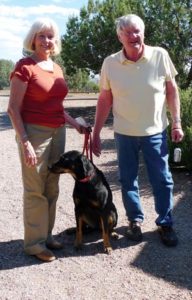
There are moments on this job that make all the heartbreak and disappointment worthwhile. Recently Sandy Nelson, who had adopted one of our shelter animals a few months ago, called me to say, “Thank you for believing Xena (pronounced Zeena) deserved a chance to live.” That was one of those moments.
When I first arrived at the Yavapai Humane Society (YHS) in July, I found Xena on the euthanasia list. Alone in her kennel, surrounded by barking dogs and abandoned by her family, she was understandably frightened. She responded to her new surroundings the only way she knew how – by demonstrating a behavior known as “fear-based aggression,” which is not uncommon in shelter dogs when they first arrive.
Although we knew she was acting out her fear, her behavior was so fearsome that our most experienced animal handlers were unable to handle her. One of them admitted that, in all his years at YHS, Xena was the only dog that actually scared him. By the time I arrived that first week in July, it had already been determined that there was no chance Xena would ever be adopted. She was marked for euthanasia.
Public safety is the primary focus when evaluating dogs for adoption. With nearly 30 years experience in animal control and welfare, I understand better than most that there are dogs who are dangerously aggressive – dogs who should never be adopted out. Was Xena such a dog?
Imagine what must go on in the mind of a dog abandoned by her guardian. You wake up as you do every morning at the foot of your master’s bed – but tonight you inexplicably find yourself alone in a cold concrete cell surrounded by excited barking dogs and strange people. Wouldn’t you lash out in fear to defend yourself?
How do you discern a truly dangerous dog from an estranged pet?

Fortunately for Xena, renowned Malibu-based dog trainer and behaviorist Robert Cabral came to the rescue. Waiving his $250 per hour fee and all the expenses he incurred from driving himself and his two dogs, Silly and Goofy, to Prescott, he came to help staff and volunteers learn his life-saving techniques.
Cabral is not your typical dog trainer. His focus is not training beloved pets how to sit and stay in your backyard. His expertise is rehabilitating behaviorally challenged shelter dogs. He has been called upon to rehabilitate dogs adjudicated as “vicious” by city magistrates – dogs most of us wouldn’t want to be in the same town with, much less on the same leash.
Believing that even these dogs deserve a chance at life is the essence of the no-kill ethic. These dogs do not come by this behavior naturally; they are trained directly or through neglect to be aggressive. The no-kill ethic asserts that every shelter animal deserves a chance at life. That means YHS will strive to treat animals in need of medical care as well as animals in need of behavioral rehabilitation in the effort to find each animal a loving home.
It was this ethic that saved Xena. The no-kill ethic created a way for the Nelsons and Xena to meet and fall in love. Today, Xena is in dog obedience classes, she happily sits for treats and she devotedly follows the Nelsons around their beautiful ranch in Chino Valley.
Cabral has a slogan: “You can’t save all the dogs in the world, but you can save one. Join the revolution.” Xena is one of many dogs benefiting from Cabral’s life-saving training. YHS staff applied what we learned and Xena responded. She overcame her fear, was removed from the euthanasia list and was adopted by the Nelsons in July.
Isn’t it time you joined the life-saving revolution? Adopt a shelter animal today.
FIV-positive cats can lead long, healthy lives by Ed Boks

In the quest to achieve No-Kill (applying the same criteria a loving pet guardian or conscientious veterinarian would apply when deciding a shelter animal’s fate), one of the challenges we must overcome is the widespread belief in many myths regarding shelter animals.
The fact is some shelter animals have issues. Equally true is the fact that these issues are seldom the animal’s fault and they can almost always be resolved. Knowingly adopting an animal with special needs is one of the noblest acts you will ever perform; you are truly saving a life.
Let me give you an example of a myth responsible for unnecessarily killing far too many animals: “cats infected with Feline Immunodeficiency Virus (FIV) should be euthanized.” The truth is FIV cats often live long, healthy lives with no symptoms at all.
FIV is an endemic disease found in domestic cats worldwide; it is a lentivirus, meaning it progresses slowly, gradually affecting a cat’s immune system. Cats are typically infected through a serious bite, usually inflicted by a stray male cat – earning it the moniker the “fighting cat” disease (a good reason for keeping your cat indoors).
The most well-known lentivirus in humans is HIV – but there are major differences between FIV and HIV. HIV cannot infect cats and FIV cannot infect humans – in fact, there is no evidence that FIV has ever infected a human in the 6,000 years humans and cats have lived together.
The fear concerning FIV cats came to my attention recently when my shelter rescued a loving 3-year-old American shorthair named Pushkin. Pushkin was surrendered by a family not because of his disease, but because they were moving out of state and sadly could not afford to take him along. Pushkin is so sweet that my team fell in love with him and tried earnestly to find him a new home. However, when potential adopters learn Pushkin has FIV, they immediately lose interest in him.
Being the proud guardian of an FIV cat named Oliver who lives happily with my other cat, Beau Bentley, I am distressed by the apprehension I find among so many cat lovers regarding FIV.
As long as FIV cats are not exposed to diseases their immune system can’t handle, they can live relatively normal lives. When kept indoors, as all cats should, health risks are significantly reduced. FIV is not easily passed between cats either. It cannot be spread casually – in litter boxes, water or food bowls, or when snuggling and playing. It requires a serious bite to transmit the disease.
Before we knew FIV existed, shelters routinely placed these cats into loving homes where they often lived long, normal lives. With the discovery of FIV in 1986 came an undeserved stigma that has since made placing them unduly difficult.
Dr. Susan Cotter, professor of hematology and oncology at Tufts University School of Veterinary Medicine, is helping counteract these misinformed fears. “I would not advise getting rid of a cat that tests positive for FIV,” she says. “If the cat is young and healthy, it could be years before anything changes.”
Best Friends Animal Society veterinarian Dr. Virginia Clemans says “the one important thing is to keep your FIV cat healthy.”
That, of course, is good advice for all cats. In fact, the very advice we offer FIV cat owners is equally appropriate for all cats. That is, all cats should be kept as healthy as possible; kept indoors and free from stress; fed a high-quality diet; and medical problems should be treated as soon as they arise.
If you already own a cat, ask your veterinarian about early detection to help maintain your cat’s health and to help prevent the spread of this infection to other cats.
Although many FIV cats live long, happy lives, some may need periodic medical care or ongoing medical management. This is why adopting a special-needs animal is such a noble and selfless act. If you can find the room in your heart and home for a cat like Pushkin, please contact your local shelter – because every animal counts.