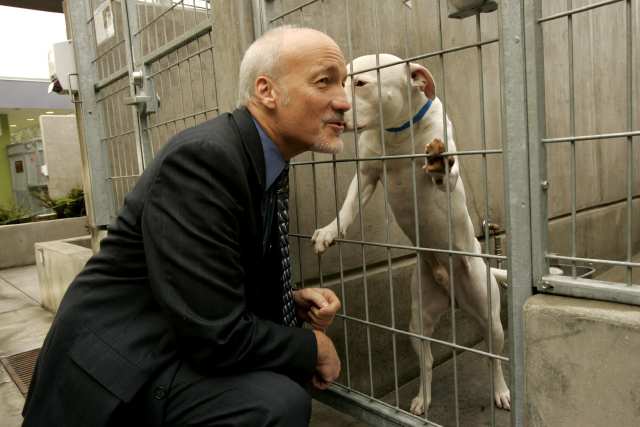
Reigning or Raining Cats and Dogs? by Ed Boks

The Yavapai Humane Society (YHS) often uses a play on words to get a message across. For instance, on Saturday, Sept. 20, YHS is celebrating its 42nd anniversary at the Prescott Resort, and the event is called Reigning Cats & Dogs.

The name Reigning Cats & Dogs is an attempt to humorously convey the role our pets play in our lives. In many ways, and for many of us, our pets take on a central, or if you will, a “reigning” role in our lives. It is in this fun spirit that we are inviting animal lovers to a royal celebration of the relationship we share with our pets.

The phrase “Reigning Cats & Dogs” is a play on the term “raining cats and dogs.”

It is ironic, even tragic, that in a community that celebrates Reigning Cats & Dogs we also experience the incessant raining of lost and homeless cats and dogs pouring into YHS every day.

So dire was the situation this past summer that YHS had to announce a state of emergency twice in response to the sheer number of lost and homeless pets finding their way into our shelters – and most were found without a license, identification tag, or microchip. Worse, pet owners did not come to YHS to identify their lost pets in a timely manner, which is a costly delay for both YHS and frantic pet owners. YHS is the central location where all lost pets are taken by local animal control and good Samaritans who rescue lost pets from the streets.

When you lose your pet, please visit the YHS Lost & Found Pet Center every three days – and more often when possible. If your pet does not have a microchip, you can purchase one at the YHS Lost & Found Pet Center Monday through Friday or at the YHS Wellness Clinic on any Friday. In the effort to reunite more lost pets with their owners, YHS is offering microchips for just $15. A microchip will help YHS reunite you with your lost pet in the shortest amount of time.

YHS is also hosting a Kitten-Palooza Adoption Special through the end of September. Kittens are available for just $50 or you can adopt two for the price of one. Every adoption (dog or cat) includes spay/neuter surgery, vaccinations and a microchip. This is over a $400 value per adoption. If you are considering adding a pet to your family, now is the time. YHS has the largest selection of quality pets available for adoption at the most affordable prices. When you adopt a pet from YHS you save two lives; the one you adopt and the one your adoption makes room for.

Another way you can help YHS is by participating in the Reigning Cats & Dogs auction, which is open online until Thursday, Sept. 18. Auction items range from luxurious vacation getaways to having your pet featured in the 2015 Yava-Paw Calendar. So tell your friends and family and let the bidding begin!  You can also purchase your tickets to the Reigning Cats & Dogs Gala scheduled for Saturday, Sept. 20 at the Prescott Resort on-line. All proceeds go to help fund YHS’s many life-saving programs. I hope to see you there!

Pets provide the best therapy By Ed Boks

Ed Boks and cat
Homer is a sage 10-year-old domestic longhair with the very rare and exotic trait called heterochromia (two different-colored eyes). He is a staff favorite with a very therapeutic personality. June is Adopt-a-Cat month at YHS, and all cats 5 years of age and older are free!

Science continues to prove what most of us know intuitively. For instance, few of us would deny pets help make us healthier by reducing stress. In fact, interacting with animals helps produce the feel-good hormone known as oxytocin, which reduces stress and helps heart attack patients live longer.

It’s been found that cats in particular can help lower the risk of heart attack and stroke by reducing spikes in our blood pressure caused by stress.

In a study of 48 men and women stockbrokers in high-paying, high-stress jobs, each was prescribed a drug for high blood pressure. Half were selected to get a cat as a pet at home. Six months later, the blood pressure of those without pets continued to rise at higher rates than those with pets.

People who care for cats are found to cope better with their own stress by tending to a cat’s needs – dealing with their own feelings later when they’re more relaxed and their minds are clearer. Cats are living, breathing companions who are always on our side, always caring and non-judgmental. Even the most supportive spouse or partner will sometimes point out our flaws, making us feel judged – which, warranted or not, causes stress.

Playing with a cat also increases serotonin and dopamine production in our brains, which explains why companion animals help reduce the symptoms of stress and depression. Pets help our overall psychological health by helping us maintain a better balance of these two chemicals. When these chemicals are out of whack, many different “negative” moods can develop, worsening existing depression and anxiety.

Another reason why cats are such great therapeutic companions is that they fulfill a basic human need for touch, especially if they’re cuddle cats. A friendly cat likes to be in physical contact with its person, lying quietly in your lap or right next to you while you’re sitting on the sofa or lying in bed, enjoying the stroking and scratching that comes with simply being there. Touch is comforting for people, and cats provide that comfort.

Cats are used as therapeutic aides in psychiatric hospitals as well. Patients who are severely depressed, anxious or having other problems are put on a couch with a calm cat in their laps, and many report feeling calmer after petting the cat.

A cat’s antics can make us laugh, even when we’re feeling at our lowest. Who doesn’t get a chuckle out of their feline friend walking nonchalantly into the room with a toy mouse or a hair tie in its mouth? Who hasn’t laughed at a cat who suddenly arches its back, puffs up its tail, and does the sideways dance at its own shadow or mirror reflection? What cat owner has never cracked a smile at their cat randomly pouncing at some invisible dust mote, only to charge off down the hallway as though the dust mote is in hot pursuit a moment later?

Laughter is a great stress-reducer, and a cat can make you laugh even when you’re feeling your lowest. Laughter has been shown to boost immunity, reduce stress and its effects), and even reduce pain. It also can relax your entire body and when you’re more relaxed you’re better able to look at your situation with a clear head and better handle problems.

If you want to take advantage of the many health benefits provided by cats, including the reduction of stress, depression, and anxiety adopt a cat from your local shelter.

YHS needs your help for blood analysis equipment By Ed Boks

The Yavapai Humane Society (YHS) is celebrating its 42nd anniversary, and we hope to further expand our “no-kill” ethic in 2014.  Many still ask what no-kill means, while others ask if it is even possible.

I define “no-kill” as applying the same criteria to deciding a shelter animal’s fate that a devoted pet owner or conscientious veterinarian would apply to a beloved pet.  That is, healthy and treatable animals are not killed simply because we lack the resources to care for them.

YHS is not a no-kill shelter; however, since the YHS Board of Directors and management team embraced the “no-kill ethic” in July 2010, we achieved a 93 percent decrease in shelter killing.  If no-kill were an Olympic event we would no doubt rejoice in our success.  However, while achieving no-kill is similar to an Olympic moment, sustaining no-kill is a marathon – and each day presents many life-and-death challenges to continue to hold the line.

YHS is the largest animal rescue organization in northern Arizona. We are increasingly known for our many life-saving programs, which are responsible for making central and western Yavapai County the safest region for pets in the United States.

So effective are our life-saving programs that often the only animals most at risk of euthanasia or delayed care are those with medical issues we are challenged to diagnose because we lack the necessary blood analysis equipment.

Consequently, YHS must rely on local labs to provide these services at considerable cost.  Often YHS just can’t afford these lifesaving services, and when we can it requires YHS staff or volunteers to spend precious time transporting samples to the lab and awaiting results.  Many times an animal doesn’t have the time it takes to get those results.

Historically, YHS euthanized suffering animals when we were unable to determine the full extent of an illness.  If YHS had a blood analysis machine the likelihood of a rescued sick pet’s survival would increase exponentially.

To ensure every ill animal that YHS rescues has a fighting chance at quality life requires this equipment on-site. This vital equipment will allow YHS to treat these critical needs animals efficiently and humanely – and it will save more lives.

In just the first quarter of 2014, YHS submitted 55 samples to local labs for analysis at an average cost of about $65. The cost for this equipment is about $20,000. If YHS had this equipment on site it would pay for itself 18 months.

This is YHS’s 42nd Anniversary. If 42 individuals could find it in their heart to give $475, YHS could secure this equipment this year. What a 42 Anniversary present for our community’s neediest animals!

If you are able to help in this life-saving effort, please mail your donation to the Yavapai Humane Society’s STAR (Special Treatment And Recovery) Program.

If you can’t afford $475, any gift towards this essential need will be greatly appreciated. Any monies above the $20,000 will go to the STAR program which provides critical medical care to sick and injured homeless animals.

Ed Boks is the executive director of the Yavapai Humane Society.

New study focuses on human-animal bond by Ed Boks

Ed Boks and human animal bond
Archaeologist finds 12,000 year old remains of a woman with her hand resting on remains of a puppy. (Photo by Naftali Hilger/Hebrew University via Getty Images)

The oldest evidence of the human/animal bond is found with a 12,000-year-old human skeleton in Israel with its hand resting on the skeleton of a 6-month-old wolf pup. Curiously, our long relationship with companion animals has only recently given rise to a field of study called anthrozoology – the study of human-animal interactions.

When you consider how long we’ve had pets in our lives, and how important they are to us it’s amazing the study of human-animal interactions is so new. Researchers have only just begun to explore this wonderful relationship.

Jeffrey Masson, author of “The Dog Who Couldn’t Stop Loving (How Dogs Have Captured Our Hearts for Thousands of Years),” opines that the human capacity for love, sympathy, empathy and compassion may actually have developed as a result of our long association with dogs.

Dr. Ann Berger, a researcher at the National Institute of Health (NIH) Clinical Center in Bethesda, Md., says “The bond animals and humans have is part of our evolution, and it’s very powerful.”

Dr. James Griffin, a scientist at NIH’s Eunice Kennedy Shriver National Institute of Child Health and Human Development, says, “There are health benefits to owning pets, both in terms of psychological growth and development, as well as physical health benefits.”

A NIH research study found that when children are asked who they talk to when they are upset, the most common answer is their pet – demonstrating the importance of pets as a source of comfort and developing empathy. Therapists and researchers also report that children with autism are sometimes better able to interact with pets, and this may help in their interactions with people.

Many studies suggest pets can help improve our cardiovascular health. One NIH study involving 421 adults who had suffered heart attacks found that dog owners were significantly more likely to be alive a year later than were those who did not own dogs, regardless of the severity of the heart attack.

Another study looked at 240 married couples. Those who owned a pet were found to have lower heart rates and blood pressure, whether at rest or when undergoing stressful tests, than those without pets. Pet owners also seemed to have milder responses and quicker recovery from stress when they were with their pets than with a spouse or friend.

One NIH investigation looked at more than 2,000 adults and found dog owners who regularly walked their dogs were more physically active and less likely to be obese than those who didn’t own or walk a dog. Another NIH study followed more than 2,500 older adults, ages 71-82, for 3 years. Those who regularly walked their dogs walked faster and longer each week than others who didn’t walk regularly. Older dog walkers also had greater mobility inside their homes than others in the study.

Man’s best friend may help you make more human friends too. Several studies have shown that walking with a dog leads to more conversations and helps you stay socially connected. Other studies have shown that people who have more social relationships tend to live longer and are less likely to show mental and physical declines as they grow older.

Several research teams are examining the benefits of bringing specially trained animals into clinical settings. Animal-assisted therapies are increasingly offered in hospitals and nursing homes nationwide and clinicians who watch patients interact with animals say they clearly see the benefits, including improved mood and reduced anxiety.

Your local animal shelter has the largest selection of mood enhancing, anxiety mitigating companion animals in your community.  Isn’t it time you took advantage of the many health benefits that comes with adopting a pet?

Putting cats to work helps them and us By Ed Boks

Ed Boks and feral catsIn a perfect world, all cats would have a loving home, they would be spayed or neutered and they would be kept indoors. Stray cat problems arise because unaltered pet cats are permitted to roam freely outdoors and they either become feral (wild) over time and/or they produce feral offspring.

The only time a cat should ever be allowed outdoors is when it is too feral to keep indoors and then only if it is spayed or neutered so it doesn’t contribute to feral cat overpopulation. However, the responsibility for making sure feral cats are spayed or neutered often unfairly falls to a compassionate person who voluntarily steps up to feed them.

Truth be known, these caregivers and their feral cats deserve our respect and our support; they provide an important service to our developing communities. They help alleviate pressure on our overcrowded shelters; they help keep rodents in check without the use of pest control chemicals that are toxic to the environment and dangerous to pets, wildlife and children; and they help reduce rodent related public health risks, such as the plague, the fatal Leptospirosis, Hantavirus Pulmonary Syndrome, Murine Typhus, Rat Bite Fever, Salmonella enterica serovar Typhimurium, and Eosinophilic Meningitis.

Feral cats have taken the place of the diminishing wild animal populations in preventing an overpopulation of rodents. This is why more and more U.S. communities are joining Denmark, England, Israel and other countries in relying on feral cats to serve as a “green” (environmentally friendly) rat abatement program.

The reason feral cats are so effective is because rodents flee neighborhoods where these cats make their presence known. They actually give off an odor through their paws as they prowl about and once rodents get a whiff of feline, they quickly vacate the premises.

Less grisly than glue traps — and much more effective – feral cats go about their “work” naturally. They prowl, they eat and they sit in the sun; although they prefer to spend much of their time hiding from view.

And the oft heard complaint that feral cats are a public nuisance can be humanely remedied through a formalized feral cat program – because, contrary to conventional wisdom, you can herd cats. Feral cats tend to follow the food bowl. Unobtrusive feeding stations established in out of the way locations ensure feral cat nuisance complaints are greatly reduced if not eliminated altogether.

I encourage municipalities to support feral cat caregivers through a program called Operation FELIX (Feral Education and Love Instead of X-termination). Through Operation FELIX, feral cats are spayed or neutered, vaccinated, micro-chipped and ear-tipped (under anesthesia while the cats are being altered, veterinarians notch an ear tip, the widely recognized sign that a feral cat is altered).

To truly be effective, local municipalities should allocate funding to support Operation FELIX in their respective jurisdictions, as they are typically the recipients of feral cat complaints. Until that happens, YHS depends on donations and grants to help support our community’s volunteer feral cat care givers as they voluntarily provide this valuable community service.

If you want to help support this innovative, non-lethal feral cat program please make a donation to your local shelter and specify “FELIX” on your check.

For more information on Operation FELIX or how to solve feral cat problems in your neighborhood contact me.

If you have a rodent problem in your home or place of business, consider adopting a Working Cat as a humane solution.

In the cold weather, be sure to tap the hood of your car before starting it. Cats often look for warmth under the hood and this simple practice could save a life.

Time to solve our feral cat problem by Ed Boks

In a perfect world, all cats would have a loving home.  Unfortunately, unaltered cats permitted to roam freely either become feral or produce feral offspring. Feral means wild, meaning these cats are unsuitable as pets.  Rather than kill feral cats I promote reducing their numbers through a process called TNR (Trap/Neuter/Return). This process is managed through an Ed Boks program called Operation FELIX (Feral Education and Love Instead of X-termination). Ed Boks and Cat

Why not just kill feral cats?  Besides being inhumane, these felines serve a valuable community purpose.  Feral cats keep rodents in check; and they do this without the use of pest control chemicals that are toxic to the environment and dangerous to pets, wildlife and children.  By reducing rodent populations, feral cats also help reduce the incidence of many diseases carried by rodents, including the Plague, Leptospirosis and Hantavirus Pulmonary Syndrome..

Feral cats are how a community controls rodent infestation and disease; TNR is how a community controls its feral cat population.

Leonardo Fibonacci, a preeminent mathematician during the Middle Ages, created a formula relating to agriculture productivity.  Six centuries later, Louis Pasteur, used this model to accurately predict that 70 percent of a susceptible population has to be vaccinated to prevent an epidemic of a contagious disease.  This discovery came to be known as Fibonacci’s 70 percent Rule which is recognized today by the World Health Organization and the Center for Disease Control.

If we consider sterilization as a method of “vaccinating” feral cats against the “disease” of overpopulation then, according to the Fibonacci Rule, 70 percent of the susceptible feral cat population in your community must be sterile to affect a population decrease.  Once the 70 percent rate is achieved, the transmission odds (successful breeding encounters) of the remaining 30 percent will only be enough to replace normal attrition.

Municipal leaders are well advised to help this effort by allocating monies to help fund Operation FELIX type programs in their local community.

Every community can choose to pay the modest costs of funding targeted spay/neuter programs designed to fix the problem or they can continue to pay the ever increasing costs of catching and killing animals.  I promote proactive solutions and hope you’ll support this effort by implementing an “Operation FELIX” program in your community.  For more information contact me.

Time to solve our feral cat problem by Ed Boks

Ed Boks and feral cats
Jay is a neutered Barn Cat. Not a feral, but not exactly a pet either, Jay is ideal for solving your rodent problems and is hoping you’ll put him to work. Contact YHS for more information on Jay.

Today is National Feral Cat Day. In a perfect world, all cats would have a loving home. Unfortunately, unaltered cats permitted to roam freely either become feral or produce feral offspring. Feral means wild, meaning these cats are unsuitable as pets. Rather than kill feral cats YHS promotes reducing their numbers through a process called TNR (Trap/Neuter/Return). This process is managed through an YHS program called Operation FELIX (Feral Education and Love Instead of X-termination).

Why not just kill feral cats? Besides being inhumane, these felines serve a valuable community purpose. Feral cats keep rodents in check; and they do this without the use of pest control chemicals that are toxic to the environment and dangerous to pets, wildlife and children. By reducing rodent populations, feral cats also help reduce the incidence of many diseases carried by rodents, including the Plague, Leptospirosis and Hantavirus Pulmonary Syndrome..

Feral cats are how a community controls rodent infestation and disease; TNR is how a community controls its feral cat population.

Leonardo Fibonacci, a preeminent mathematician during the Middle Ages, created a formula relating to agriculture productivity. Six centuries later, Louis Pasteur, used this model to accurately predict that 70 percent of a susceptible population has to be vaccinated to prevent an epidemic of a contagious disease. This discovery came to be known as Fibonacci’s 70 percent Rule which is recognized today by the World Health Organization and the Center for Disease Control.

If we consider sterilization as a method of “vaccinating” feral cats against the “disease” of overpopulation then, according to the Fibonacci Rule, 70 percent of the susceptible population in the Quad-City region must be sterile to affect a population decrease. Once the 70 percent rate is achieved, the transmission odds (successful breeding encounters) of the remaining 30 percent will only be enough to replace normal attrition.

YHS has secured grants to help fund Operation FELIX, but to achieve 70 percent more help is needed. Municipal leaders can help by allocating monies to help fund Operation FELIX. YHS will match each municipality’s allocation to this program with dedicated grant monies to help their respective neighborhoods.

As a community we can choose to pay the modest costs of funding targeted spay/neuter programs designed to fix the problem or we can return to paying the ever increasing costs of catching and killing animals. YHS promotes proactive solutions and hopes you’ll support this effort by sending a donation to “Operation FELIX” or by volunteering to help staff this program. For more information, visit www.yavapaihumane.org/felix or call 445-2666 to sign up for a TNR class.

If you currently manage or feed a feral cat colony, call the YHS Spay/Neuter Clinic to schedule an appointment to have your cats sterilized. Grant monies may allow you to have this done for free. Call 771-0547 for more information.

No Kill here to stay? by Ed Boks

Ed Boks and Reigning Cats and Dogs
Ed Boks and Board President Gloria Hershman present the prestigious YHS Founder’s Award to Kathy Coleman, John Tarro and Max Fogleman.

What a celebration! I’m talking about the Yavapai HumaneSociety’s annual Reigning Cats & Dogs Gala this past Saturday. This year we celebrated YHS’s 41st anniversary and the role the organization has played in transforming  Yavapai County into the safest, pet-friendliest community in the nation!

As we celebrated the many successes of the past four decades, a big question concerning YHS’ future was put before the over 350 Gala celebrants. That question was this: Is no-kill here to stay? Was the success of the past three years an anomaly or a beachhead?

The resounding response of the gala guests was “Yes, no-kill is here to stay” – and their commitment to the “no-kill” ethic was demonstrated by a record yield in donations dedicated to funding the Yavapai Humane Society’s many life-saving programs.

At this year’s event, YHS Board President Gloria Hershman presented the prestigious Yavapai Humane Society Founder’s Awards to former board members John Tarro, Kathy Coleman and Max Fogleman. This dynamic trio helped guide YHS through some of its most difficult years while laying the foundation for YHS’s most recent successes.

One of the livelier auction items was for naming rights for the new YHS Cat Care Center. The opening bid was $10,000 and, after a fun and exciting bidding war with Hooligan’s proprietors Pat and Nancy O’Brien, Don and Shirl Pence emerged the winners with a $32,000 bid.

In addition to winning the naming rights for the new Pence Cat Care Center, Don and Shirl served their traditional role as this year’s Founders of the Feast by underwriting another year’s gala. Without their generous support, and the support of so many others, YHS could never accomplish all that it does.

The Pences were recognized along with Lou Silverstein and Peggy Stidworthy in the first-ever Founder’s Award Presentation at last year’s gala. The vision, leadership and generosity of all our founders laid a sure foundation for YHS and we are profoundly grateful to them all.

Would you like to help make sure “no-kill” is here to stay? Please consider joining these visionaries in their support of the “no-kill ethic” through the YHS PAWS program. Together we can continue to make our community the safest in the nation for pets.

You can do this by donating just $10 a month to ending the killing of adoptable pets. What a difference that would make! With that kind of steady support, YHS could reliably continue to save animals’ lives, fight cruelty, and rescue and protect lost, homeless, sick, abused and neglected animals in our community.

And it’s easy to participate in the YHS PAWS (Planned Automatic Withdrawal Service) program. You’ll be joining a growing number of people who are making our entire community a true humane society. By joining PAWS you simply choose the amount that feels comfortable to you; and you can change or cancel your participation any time.

A monthly contribution of just $10 (or more) helps feed hungry homeless animals, provide life-saving medicine to ailing animals, and vaccinate and spay/neuter needy pets to help reduce pet disease and overpopulation. Where else can so little do so much?

What to do in a dog attack by Ed Boks

What is the tool of choice when breaking up a serious dog fight? First, let’s review the ineffective tools commonly used.

Contrary to popular opinion, pepper spray and Mace are seldom effective. In fact, these agents are known to actually provoke dogs into redirecting their aggression. Because these agents must be accurately directed at close range the person applying the agent is often the target of this redirection – and if the person is affected or overcome by the agent (which depends on which way the wind is blowing) the consequences to the person can be severe.

Tasers are virtually useless against fur-covered animals; and tranquilizer darts must be placed accurately to be effective, which is difficult when a dog is in attack mode; and the tranquilizer takes several minutes to work during which time the animal can do significant damage.

What then is the best way to break up a dog fight without injuring the animals or putting yourself at unnecessary risk?  I recommend fire-extinguishers. Ed Boks fire extinguisher

With a fire-extinguisher, an intervener does not have to closely approach the dogs or have an accurate aim to deter an attack. Fire-extinguishers don’t quickly run out of “ammunition” or produce an erratic ricochet; and they are non-lethal. If the fire-extinguisher is exhausted while the dog attack continues the empty cylinder can be used as a shield or a bite stick.

Fire-extinguisher contents tend to make animals short of breath without lasting harm; and most dogs retreat from the snake-like hiss of a discharging fire-extinguisher.

Fire-extinguishers can be found in most every kitchen, near every fireplace, and in every car, bus, truck, taxi, and patrol car, and they are prominently located in every public building and place of business.

Should the unfortunate happen and you are bitten it’s best to push against the biter instead of pulling away; this forces most dogs to open their mouths, and enables the victim to avoid the ripping injuries that result from pulling away from a dog’s serrated teeth. However, this strategy may not be universally applicable to all dog bites.

In fatal and disfiguring attacks, the first bite often disables the victim preventing them from pushing against the bite, or protecting themselves, or doing any of the other things conventionally advised. The only effective defense against this type of an attack is preventing the attack from occurring in the first place.

When attacked by a dog it is important to understand dogs tend to attack whatever part of a person is closest to them, so putting an object, any object, between you and the dog will likely redirect the attack towards the object in your hand and away from you.

It’s important to keep your balance. Fending off a dog attack by swinging an object, such as a baseball bat or a golf club, is dangerous; the dog may dodge the blow and take advantage while the person is off-balance to inflict serious injury. The correct way to use a bat or golf club is as a bite-stick held out to keep the dog at maximum distance from oneself.

Most dog on dog and dog on person attacks can be prevented by properly training and socializing your pet. It is never too late to invest in your canine companion by teaching him “good citizenship” skills.

Lastly, remember to keep your dog on a leash six feet or less in length in public places. Not only is this the law (yes, retractable dog leashes are illegal in public places), but a short leash gives you better control to either prevent or save your dog from an attack.

Government shutdown has negative impact on animals by Ed Boks

As the budget stalemate in Washington led to a temporary government shutdown animal advocates are wondering how this unusual event will impact those who have no voice – our nation’s animals.

Here is a brief outline describing how the following animal welfare-related duties are being affected during this shutdown:

Puppy Mills: The United States Department of Agriculture (USDA) is not Ed Boks and puppy millperforming all of its duties under the Animal Welfare Act. Specifically, it is not inspecting puppy mills or pet dealers. During this break in oversight, untold harm could be done to commercially bred animals simply because no one is empowered to monitor their safety. The puppy mill industry is notorious for egregious animal abuse and neglect; the mind reels at what these animals will suffer without any oversight.

Horse Soring: Soring involves the intentional infliction of pain to a horse’s legs or hooves to force the horse to perform an artificial, exaggerated gait. Caustic chemicals and blistering agents like mustard oil, diesel fuel and kerosene are applied to the horse’s limbs, causing extreme pain. Ed Boks and horse

Another form of soring, known as pressure shoeing, involves cutting a horse’s hoof almost to the quick and tightly nailing on a shoe, or standing a horse for hours with the sensitive part of his soles on a block or other raised object. This causes excruciating pressure and pain whenever the horse puts weight on the hoof.

The USDA’s Animal and Plant Health Inspection Service (APHIS) is charged with enforcing the Horse Protection Act to combat the abusive practice of horse soring. APHIS oversees the inspection of at-risk show horses to ensure they have not been sored and assesses penalties for violations. Suspension of the APHIS program will allow unscrupulous trainers to take advantage of this lapse in oversight.

Animal Slaughter: The USDA’s Food Safety and Inspection Service (FSIS) uphold the requirements of the Humane Methods of Slaughter Act related to the treatment of animals prior to and during slaughter. This has been deemed a necessary function, so FSIS inspectors will continue to monitor food safety and humane treatment of animals in slaughterhouses during the shutdown.

Wild Horses: Federal agencies periodically round up and remove large numbers of free-roaming wild equines on public rangelands. This policy often results in tens of thousands of wild horses languishing in holding facilities. Roundups are suspended during the shutdown, but caretakers for the horses already confined will remain on the job.

Zoos/Circuses: Exotic animal exhibitors are regulated by the Animal Welfare Act; unfortunately, the welfare of these animals is suspended for the time being.

Animals in Laboratories: The USDA enforces the AWA to ensure minimumEd Boks and monkey standards of care for animals in laboratories. While employees are on the job maintaining the animals, there is no USDA watchdog ensuring that minimum standards of care are being met. This is another industry whose history is seriously tainted by egregious animal abuse and neglect. The temporary lack of oversight puts these animals again at great risk.

Every community must develop policies and programs that serve as a safety-net during those times when the federal government fails us.